
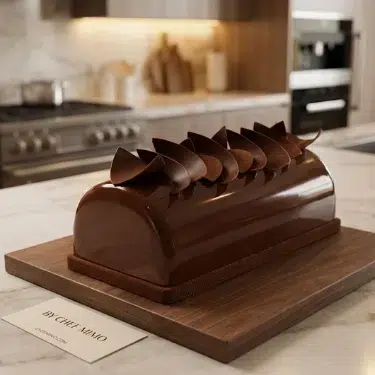
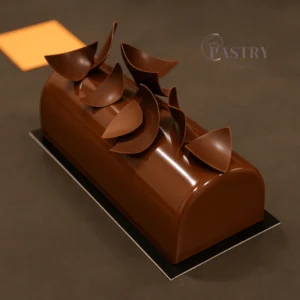
🎄🍫 Ultimate All-Chocolate Yule Log (Bûche de Noël) Brownie Base, Hazelnut Crunch, Dark Chocolate Cremieux & Milk Chocolate Mousse
A Study in Chocolate Intensity: Introduction to the Bûche de Noël
The Bûche de Noël (Yule Log) is the undisputed centerpiece of the French holiday table. While the tradition dates back to burning a literal log in the hearth for prosperity, modern pâtisserie has evolved it into a sophisticated entremet that mimics the shape but elevates the experience. Developed in collaboration with Chef Philippe, this Ultimate All-Chocolate Yule Log is a masterclass in texture profiling.This dessert is not simply "chocolate cake." It is a curated journey through cocoa percentages. It features the deep, acidic intensity of 70% Ocoa Dark Chocolate in the crémeux and the creamy, lactic sweetness of 41% Alunga Milk Chocolate in the mousse. Anchoring these airy layers is a dense, fudgy Brownie Sponge and a shattering Hazelnut Crunch layer.Why is this recipe a showstopper? It solves the "monotone" problem often found in chocolate desserts. By playing a high-cocoa dark chocolate against a specifically formulated "mousse-profile" milk chocolate, the palate is constantly engaged. The addition of candied orange in the crunch layer provides a subtle citrus perfume that lifts the heaviness of the fats, making this rich dessert surprisingly digestible after a heavy Christmas feast.Ingredients
✳️ Dark Chocolate Cremieux
- 300 g heavy cream 30%
- 45 g egg yolks
- 12 g sugar
- 2.5 g gelatin powder 200 bloom
- 15 g cold water for gelatin
- 120 g Ocoa 70% dark chocolate
- Pinch of fleur de sel
✳️ Chocolate Brownie Sponge
- 75 g Inaya 65% dark chocolate
- 70 g butter
- 30 g egg yolks
- 10 g sugar for yolks
- 10 g sugar for egg whites
- 50 g egg whites
- 17 g flour
- 25 g chopped hazelnuts
✳️ Hazelnut Crunch
- 20 g almond-hazelnut praliné
- 13 g crushed crêpes dentelles
- 45 g toasted chopped hazelnuts
- 6 g candied orange cubes
- 37 g Alunga 40% milk chocolate
✳️ Alunga Milk Chocolate Mousse
- 115 g whole milk
- 260 g Alunga 40% milk chocolate
- 315 g whipped cream soft peaks
✳️ Dark Chocolate Mirror Glaze
- 106 g water
- 200 g sugar
- 200 g glucose syrup
- 134 g sweetened condensed milk
- 200 g Ocoa 70% dark chocolate
- 12 g gelatin powder 200 bloom
- 72 g cold water for gelatin
Mastering Textures and Flavors📗 Download your PDF now!
Instructions
Dark Chocolate Crémeux
- Hydrate gelatin in cold water. Prepare a crème anglaise by heating cream with yolks and sugar to 83°C. Add gelatin and pour over chopped dark chocolate and salt. Emulsify, then pour into the insert mold and freeze for at least 6 hours.
Brownie Sponge
- Melt chocolate with butter. Whip yolks with 10 g sugar and combine with chocolate. Whip egg whites with 10 g sugar to soft peaks. Fold into chocolate mixture, then add sifted flour. Pour into a 16 cm square frame and top with hazelnuts. Bake at 160°C for 20–25 minutes. Cool and reserve.
Hazelnut Crunch
- Mix praliné, crêpes dentelles, hazelnuts, candied orange, and melted milk chocolate. Spread on top of the cooled brownie. Cut to the mold's base size and chill.
Alunga Milk Chocolate Mousse
- Heat milk and pour over chopped Alunga chocolate. Let sit, then whisk into a smooth ganache. When at 35°C, fold in whipped cream in two stages.
Assembly
- Pour 2/3 of the mousse into the bûche mold and push up the sides. Add frozen insert. Cover with remaining mousse and place brownie (crunch side down) on top. Freeze for 12 hours.
Mirror Glaze
- Hydrate gelatin in cold water. Heat water, sugar, and glucose to 103°C. Pour over condensed milk and chocolate. Add gelatin. Blend and chill for 6 hours.
🎉 Finishing
- Unmold the frozen bûche. Re-freeze slightly if needed. Warm glaze to 35°C and blend. Pour over the bûche on a wire rack. Decorate with dark and milk chocolate elements. Refrigerate for at least 6 hours before serving.
Notes
The Science of Ingredients: The Alchemy of Texture
To achieve the perfect slice where every layer remains distinct, we must understand the chemistry at play.1. Crêpes Dentelles (The Hydrophobic Crunch)
The recipe calls for "crushed crêpes dentelles" (dried lace pancakes) mixed with praliné and chocolate.- The Science: Crêpes dentelles are extremely hygroscopic—they love to absorb water. If you placed them directly onto the brownie or mousse, they would turn to mush within hours. By mixing them with Praliné (nut oil) and Milk Chocolate (cocoa butter), we are essentially "waterproofing" them. The fat coats every shard of the crêpe, creating a barrier against the moisture in the mousse, ensuring the crunch remains audible even after 2 days in the fridge.
2. Ocoa vs. Alunga (Fermentation Profiles)
This recipe specifies Cacao Barry "Ocoa" and "Alunga."-
The Science: Not all chocolates are interchangeable.
- Ocoa (70%) is a "New Generation" fermentation chocolate, known for high acidity and low cocoa butter. In a crémeux, this acidity cuts through the richness of the egg yolks and cream, providing a "clean" finish.
- Alunga (41%) is a "Q-Fermentation" milk chocolate designed specifically for mousses. It has a higher cocoa mass than standard milk chocolate but retains strong milky notes. This ensures the mousse doesn't taste "washed out" when diluted with whipped cream.
3. Crème Anglaise (The Emulsified Base)
The crémeux starts by cooking cream, sugar, and yolks to 83°C.- The Science: This is the temperature of "nappe" (coating consistency). At 83°C, the egg yolk proteins (specifically ovotransferrin and ovalbumin) denature and unfold, thickening the liquid into a custard. If you stop at 75°C, the bridge is weak and the crémeux will be runny. If you go to 85°C+, the proteins bond too tightly, squeezing out water and creating a grainy "scrambled" texture. Precision here creates the silky mouthfeel that contrasts with the airy mousse.
4. Glucose Syrup (The Anti-Crystallizer)
The glaze uses a high ratio of glucose.- The Science: A Yule log has vertical sides. Gravity pulls glaze down faster than on a flat cake. Glucose syrup adds viscosity (body), allowing the glaze to cling to the sides in a thick, opaque layer. Chemically, it also acts as an "interfering agent," preventing the sucrose molecules from bonding into crystals, ensuring the glaze remains a flawless mirror rather than becoming gritty.
Essential Professional Kitchen Tools
A Yule log requires specific architecture. Here is your construction kit.-
Yule Log Mold (Bûche Mold) & Insert Tube
- Why you need it: Unlike a round cake, a log requires a U-shaped trough mold. You also need a smaller "tube" mold for the frozen crémeux insert. If you don't have a tube mold, you can pipe the crémeux into a cylinder shape using plastic wrap, but a silicone mold guarantees a perfect circle in the cross-section.
-
Digital Thermometer
- Why you need it: Essential for the Crème Anglaise (83°C) and the Mirror Glaze (35°C). Visual cues are unreliable with dark chocolate mixtures.
-
Rectangular Cake Board / Cardboard
- Why you need it: Logs are long and fragile. You need a gold cardboard rectangle cut exactly to the size of the base to support the cake when you move it from the glazing rack to the serving platter. Without it, the log will snap in the middle.
-
Immersion Blender
- Why you need it: For the glaze and crémeux. It creates a "vortex" that forces fat and liquid into a stable emulsion without incorporating air bubbles. Air bubbles in a black mirror glaze look like white specks and ruin the finish.
Expert Tips and Success Hacks
Achieve a boutique-bakery finish with these five professional secrets.1. The "Hidden Base" Technique
You never want the biscuit to stick out at the bottom of the log.- The Hack: Cut your brownie and crunch layer 1cm smaller (in both width and length) than the opening of your log mold. When you place the base on top of the mousse (which is technically the bottom), the mousse will squish up the sides, encasing the biscuit. When you unmold it, the cake will sit "inside" the mousse, creating a seamless line where the cake meets the board.
2. The Temperature Bridge
Folding whipped cream into chocolate is dangerous.-
The Hack: The chocolate base for the mousse must be at 35°C–40°C.
- Too Hot (>45°C): It will melt the fat in the whipped cream, destroying the air bubbles and resulting in a heavy, liquid soup.
- Too Cold (<30°C): The cocoa butter will seize when it hits the cold cream, creating chocolate chips/grains in your mousse ("stracciatella effect").
3. Glazing the Spine
Glazing a cylinder is harder than glazing a flat disc because the glaze runs off the "spine" (top) very quickly.- The Hack: Pour a generous amount of glaze directly along the very top center line of the log first. Let it cascade down the sides. Do not pour in circles. One confident pour along the spine ensures the top isn't too thin/transparent.
4. The Hot Knife Finish
The ends of a Yule log can look messy if not trimmed.- The Hack: After glazing and chilling the log, slice off a thin layer (0.5cm) from both ends using a knife dipped in hot water and wiped dry. This reveals the beautiful layers inside (the "cut") and removes the uneven glaze drips at the ends. Place chocolate squares (or "embouts de bûche") on these ends to hide the cut if preferred.
5. Stabilizing the Insert
A crooked insert ruins the slice.- The Hack: When you push the frozen crémeux tube into the mousse, use a ruler to gently press it down evenly. Ensure it is centered. If it sinks to the bottom, your mousse was too runny (see Tip #2). The mousse should be thick enough to hold the insert suspended in the middle.
Frequently Asked Questions (FAQ)
Q1: Can I use a regular loaf pan if I don't have a Yule Log mold? A: Yes. Line a metal loaf pan with acetate or plastic wrap (smoothly). The shape will be rectangular rather than round, but the taste will be identical. You can round off the edges with a knife after freezing if you want a cylindrical look. Q2: Can I substitute the Ocoa/Alunga chocolates? A: Yes, but try to match cocoa percentages. For Ocoa, use a 70% dark chocolate. For Alunga, use a high-quality milk chocolate (around 40%). If using supermarket milk chocolate (usually 25-30% cocoa), the mousse will be sweeter and less chocolatey, so you might want to reduce the sugar slightly. Q3: How far in advance can I make this? A:- Frozen (Unglazed): Up to 1 month.
- Glazed (Thawed): 2 days in the fridge. The glaze is best within 24 hours as it keeps its shine. The crunch layer will stay crisp for about 48 hours.
Tried this recipe?Let us know how it was!

I’m Chef Mimo, a passionate pastry chef with over 17 years of experience in the world of fine desserts. I specialize in French-style entremets, refined cakes, and creative chocolate work. Pastry is not just my profession—it’s my lifelong passion. Through PastryCrafted.com, I love sharing my recipes, techniques, and inspirations with anyone who dreams of mastering the art of pastry. Whether you’re a curious beginner or a seasoned pro, you’re welcome in my sweet world.