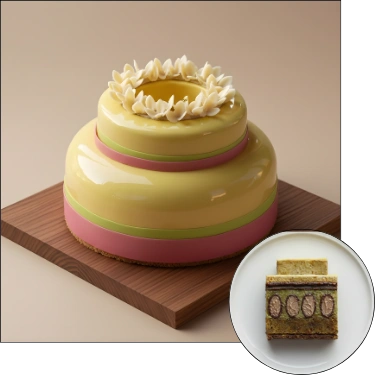
Easter Cake Entremet

A festive, layered entremet featuring rich pistachio marzipan cake, crunchy chocolate pistachio praliné, smooth ganache, and a light pistachio mousse, finished with a pastel mirror glaze and decorated chocolate bonbons.

Yields: 10 Servings

Target Mold Size: 18 cm diameter silicone mold (e.g., Silikomart Universo)

DAY ONE: Component Preparation & Internal Assembly

1. Pistachio Chocolate Crunch

IngredientsWeight (g)Notes
Caster Sugar25 g 
Roasted Pistachio Nuts20 g 
Milk Chocolate (30-35% cocoa solids)65 gMelted
Pistachio Cream (Spread/Crema)35 gHigh-quality, smooth pistachio spread
Feuilletine Flakes35 g 
Fine SaltPinch 

Method

  1. Prepare Caramelized Pistachios: Melt the caster sugar in a dry pan over medium heat to a golden-brown caramel. Immediately stir in the roasted pistachio nuts until completely coated. Pour onto a silicone mat or parchment paper and allow to cool completely. Finely chop the caramelized nuts.
  2. Melt Chocolate: Gently melt the milk chocolate using a bain-marie or microwave (in short bursts). Set aside.
  3. Combine Crunch: Fold the feuilletine flakes, fine salt, and finely chopped caramelized pistachios into the melted milk chocolate.
  4. Add Pistachio Cream: Stir in the pistachio cream until fully combined.
  5. Set and Cut: Roll the crunch mixture out evenly between two sheets of parchment paper. Chill in the refrigerator until firm.
  6. Final Cut: Once set, use a clean 16 cm diameter pastry ring to cut a perfect circle from the crunch layer. Place this layer into a clean 16 cm ring lined with an acetate collar and a parchment base, ready for the cake layer.

2. Pistachio Marzipan Cake (Layer 1)

IngredientsWeight (g)Notes
Raw Marzipan70 gGrated
Soft Unsalted Butter70 gSoftened, room temperature
Caster Sugar60 g 
Large Egg75 gWeigh 1 full egg plus 1/2 of a second egg, room temperature
Pistachio Flour55 gMade from roasted pistachios (see instructions below)
Fine SaltPinch 
Baking Powder1.2 gApproximately 1/4 tsp
All-Purpose Flour30 g 
Lemon Zest2 gEquivalent of 1 tsp
Milk ChocolateSmall amountMelted, for gluing to crunch layer

Method (Pistachio Flour)

  1. Roast 55 g of pistachio nuts at 175°C for 5 to 7 minutes until fragrant. Allow to cool completely.
  2. Blend the cooled nuts in a food processor until they form a fine, evenly-textured flour.

Method (Cake)

  1. Preheat and Prepare: Preheat the fan oven to 180°C. Line an 18 cm diameter pastry ring/springform pan with parchment paper.
  2. Cream Base: Using a hand mixer, beat the soft butter, caster sugar, fine salt, and grated marzipan until the mixture is light and fluffy.
  3. Add Eggs: Incorporate the eggs gradually, mixing well after each addition.
  4. Fold Dry Ingredients: Gently fold in the pistachio flour, all-purpose flour, baking powder, and lemon zest using a rubber spatula until just combined.
  5. Bake: Pour the batter into the prepared 18 cm ring. Bake for approximately 13 to 16 minutes, or until golden and set in the middle.
  6. Cool and Set Base: Allow the cake to cool completely. Lightly brush the 16 cm Pistachio Chocolate Crunch base with a small amount of melted milk chocolate. Place the cake layer on top of the crunch layer (within the 16 cm ring). Gently level the surface with a flat tool.
  7. Chill: Freeze the combined layer for 15 minutes to allow the base to set.

3. Chocolate Easter Eggs Layer

IngredientsWeight (g)Notes
Small Easter Chocolate Eggs65-70Approximately 3 cm tall, high-quality with soft filling
Milk Chocolate30 gMelted, for gluing eggs

Method

  1. Prepare Eggs: Ensure you have enough eggs to completely cover the cake layer. Melt the 30 g of milk chocolate.
  2. Assemble Layer: Using a piping bag or small spoon, apply a small dab of melted chocolate to the bottom and sides of an Easter egg and place it on the chilled Pistachio Marzipan Cake layer.
  3. Repeat, placing the eggs in long, tight rows rather than a spiral pattern for a cleaner cake cut.
  4. Fill any remaining gaps or holes around the side perimeter with chocolate eggs cut to size. The goal is to ensure no visible holes are left uncovered.
  5. Freeze: Return the cake base and egg layer to the freezer while preparing the ganache.

4. Pistachio Ganache (Insert Filling)

IngredientsWeight (g)Notes
White Chocolate (30-35% cocoa butter)160 gFinely chopped
Pistachio Cream (Spread/Crema)160 g 
Heavy Cream (35% fat)139 gEquivalent of 135 ml
Lemon Juice (fresh)25 gEquivalent of 25 ml
Fine Sea SaltPinch 

Method

  1. Melt: Gently melt the white chocolate and pistachio cream together in a saucepan until smooth. Transfer to a bowl.
  2. Heat Cream: In a separate saucepan, bring the heavy cream and lemon juice almost to a boil.
  3. Emulsify: Pour the hot cream mixture over the chocolate/pistachio mixture. Stir firmly in the center of the mixture with a rubber spatula until the ganache becomes glossy and homogenous.
  4. Blend and Fill: Pour the ganache into a plastic jug and blend with an immersion blender. Transfer the ganache to a piping bag with a tiny hole.
  5. Layer: Pipe the ganache around the Easter eggs, specifically aiming to fill all the gaps between the eggs first. Gently tap the mold on the workbench to distribute the ganache and release air bubbles.
  6. Level: Spread the remaining ganache just enough to cover the top surface of the Easter eggs, ensuring the final layer is the same height as the eggs for a clean internal cut.
  7. Chill: Save the ganache leftovers in an airtight container in the refrigerator for the Easter Egg Bonbons. Freeze the cake insert while preparing the next layer.

5. Marzipan & Chocolate Layer (Layer 2)

IngredientsWeight (g)Notes
Raw Marzipan120 g 
Milk Chocolate (30-35% cocoa solids)35 gTempered

Method

  1. Prepare Marzipan: Roll out the 120 g of marzipan evenly between two pieces of parchment paper to fit a 16 cm diameter pastry ring. If the marzipan is too sticky, knead a small amount of icing sugar into it before rolling.
  2. Temper Chocolate: Temper the 35 g of milk chocolate.
  3. Combine: Spread a layer of the tempered chocolate on one side of the rolled marzipan using a palette knife.
  4. Place: Before the chocolate sets, carefully place the marzipan layer on top of the Pistachio Ganache, with the tempered chocolate facing the ganache layer.
  5. Chill: Gently level the surface with a flat glass. Freeze the cake insert while preparing the final layer.

6. Pistachio Cocoa Praliné (Layer 3)

IngredientsWeight (g)Notes
Roasted Pistachio Nuts90 g 
Caster Sugar90 g 
Sunflower Oil14 gEquivalent of 3 tsp (density approx 0.9 g/ml)
Cocoa Powder5 gEquivalent of 2 tsp

Method

  1. Caramelize: Melt the caster sugar in a dry saucepan over medium heat to a deep golden caramel. Immediately add the roasted pistachio nuts and stir to ensure all nuts are completely coated.
  2. Cool: Pour the caramelized nuts onto parchment paper or a silicone mat and allow them to cool and harden completely.
  3. Process: Break the cooled praliné into large chunks. Process the chunks in a high-speed food processor until the mixture transitions to a smooth nut butter consistency.
  4. Add Flavoring: Once the praliné is almost smooth, add the cocoa powder and sunflower oil. Blend again until a fully smooth, pourable praliné is achieved.
  5. Layer: Pour the praliné into a piping bag and spread a 0.5 cm layer evenly over the set marzipan layer. Level the surface with a spoon or palette knife to create a perfectly flat top.
  6. Final Freeze: Cover and freeze the entire 16 cm insert overnight.

DAY TWO: Mousse & Entremet Construction

7. Pistachio Mousse

IngredientsWeight (g)Notes
Gelatin Sheet (240 Bloom)6.6 gApproximately 3 3/4 sheets, Extra Gold, bloomed
White Chocolate (30-35% cocoa butter)140 gFinely chopped
Pistachio Nut Paste (Sub-recipe)130 gSee preparation notes below
Heavy Cream (for heating)200 g 
Heavy Cream (for whipping)300 gChilled

Method (Pistachio Nut Paste – Sub-recipe)

  1. Blend 130 g of roasted pistachio nuts with 4.5 g of icing sugar and 7 g of neutral oil (e.g., sunflower) in a high-speed mini chopper until a thick, smooth nut butter/paste is achieved.

Method (Mousse)

  1. Bloom and Melt: Soak the gelatin in ice-cold water for 5 to 10 minutes. Gently melt the white chocolate and transfer it to a large mixing bowl.
  2. Combine Chocolate and Paste: Stir the prepared 130 g pistachio nut paste into the melted white chocolate until homogenous.
  3. Infuse Cream: Heat 200 g of heavy cream almost to a boil. Remove from heat, squeeze the excess water from the bloomed gelatin, and whisk it into the hot cream until fully dissolved.
  4. Emulsify: Pour the hot cream mixture over the chocolate/pistachio mixture while stirring gently from the center outwards with a rubber spatula until combined.
  5. Cool and Temper: Allow the mass to cool to lukewarm (approx 28°C).
  6. Whip Cream: Whip the remaining 300 g of heavy cream to soft, light peaks.
  7. Fold: Gently fold the whipped cream into the cooled chocolate/pistachio mixture in three additions, maintaining the airy structure of the mousse.

8. Assembly, Part 4 (Final Entremet Build)

  1. Prepare Main Mold: Place the 18 cm silicone mold on a flat cutting board. Line the mold with a tall acetate collar, as the final cake will exceed the mold height.
  2. Pour Mousse (Main): Pour 400 g of the Pistachio Mousse into the mold.
  3. Insert Core: Retrieve the frozen 16 cm cake insert. Carefully place the insert into the mousse, pressing it down until the praliné layer is fully submerged and the top of the cake insert is level with the mousse.
  4. Prepare Topping Mousse: Line a 12 cm diameter round silicone mold (or a 12 cm pastry ring with a tight cling film base) with an acetate collar.
  5. Pour Mousse (Topping): Pour a 3 cm layer of the remaining mousse into the 12 cm mold/ring.
  6. Freeze: Freeze both the 18 cm cake entremet and the 12 cm mousse dome overnight until fully solid.

9. Easter Egg Bonbons (Decoration Prep)

MaterialsWeight (g)Notes
White Chocolate (Shells)260 gTempered
White Pearl Cocoa ButterFor mold coloring
Pistachio Ganache LeftoversRoom temperature

Method

  1. Temper Ganache: Remove the refrigerated Pistachio Ganache leftovers (from Step 4) and allow them to come to room temperature to be pipeable.
  2. Prepare Mold: Polish your Easter egg bonbon mold with cotton pads for a shiny finish. Paint the mold interior with the white pearl cocoa butter color, repeating 2 to 3 times until the shell is fully covered and opaque.
  3. Shells: Temper the 260 g of white chocolate and place it in a piping bag. Fill each mold cavity with chocolate. Tap the mold gently on the workbench to release air bubbles.
  4. Remove Excess: Immediately turn the mold upside down and pour out as much chocolate as possible, using a palette knife to tap the side of the mold to thin the shell. Scrape the surface of the mold clean to remove excess chocolate. Flip the mold back over and scrape the surface a second time.
  5. Set Shells: Chill the mold in the refrigerator until the chocolate shells are set.
  6. Fill: Pipe a layer of the room-temperature Pistachio Ganache into each cavity, ensuring you leave enough space to seal the bottom. Chill the mold until the ganache surface is set.
  7. Seal: Re-temper the white chocolate (or use any leftover from the shell process). Pipe the tempered chocolate onto the bottom of the cavities. Tap the mold gently and use a chocolate scraper to remove the excess chocolate, sealing the bonbons. Chill the mold until fully set.
  8. Assemble Eggs: Release the finished bonbons from the mold. Gently heat a small, clean pan. Quickly place the edges of two halves onto the hot surface just long enough to melt the chocolate slightly, then press them together to form a sealed Easter egg. Repeat until you have at least 7 eggs. Store in an airtight container in the fridge.

DAY THREE: Glazing, Decoration & Final Finish

10. Mirror Glaze (Glaçage Miroir)

IngredientsWeight (g)Notes
Gelatin Sheet (240 Bloom)17.5 g10 sheets, Extra Gold, bloomed
White Chocolate (30-35% cocoa butter)250 gFinely chopped
Heavy Cream (35% fat)175 gEquivalent of 170 ml
Water85 gEquivalent of 85 ml
Caster Sugar250 g 
Glucose Syrup250 g 
Food Coloring PasteYellow, white, and a touch of orange to achieve pastel yellow/orange

Method

  1. Bloom Gelatin: Soak the gelatin in ice-cold water for 5 to 10 minutes.
  2. Prepare Syrup: Place the finely chopped white chocolate into a large plastic pitcher. In a saucepan, combine the sugar, water, heavy cream, and glucose syrup. Heat almost to a boil. Remove from heat, squeeze the excess water from the gelatin, and whisk it into the hot syrup until dissolved.
  3. Emulsify Glaze: Pour the hot liquid over the white chocolate. Allow to rest for 1 minute. Add the coloring pastes (yellow, white, and orange). Use an immersion blender to emulsify the mixture.
  4. Cool and Temper: Cover the surface of the glaze directly with cling film and allow it to cool to its working temperature of 34°C to 35°C.
  5. Glaze: Retrieve both the 18 cm cake and the 12 cm mousse dome from the freezer. Place them on a baking cooling rack set over a tray. Pour the glaze over both frozen elements.
  6. Set Glaze (Base): Place the 18 cm cake on a cake plate. Allow the glaze to set slightly for 2 to 3 minutes.
  7. Position Dome: Use a 12 cm diameter pastry ring to mark the center of the cake top as a guide. Carefully lift the 12 cm mousse dome and place it precisely onto the marked center of the larger cake.
  8. Thaw: Allow the entire cake to thaw in the refrigerator for approximately 6 hours before decorating further.

11. Chocolate Decoration (Ribbons)

MaterialsWeight (g)Notes
White Chocolate240 gTempered
Green Food Coloring PowderFor ribbons
Pink Food Coloring PowderFor ribbons
FlowersFor final garnish

Ribbon Dimensions (for 18 cm cake base):

  • Green Ribbon 1 (Widest): 3.5 cm x 59 cm
  • Pink Ribbon 2 (Middle): 2.5 cm x 59 cm

Ribbon Dimensions (for 12 cm mousse dome):

  • Green Ribbon 3: 1.5 cm x 40 cm
  • Pink Ribbon 4: 0.7 cm x 40 cm

Ribbon Dimensions (for top accent):

  • Ribbon 5: 1 cm x 25 cm (for 8 cm diameter placement)

Method

  1. Temper Chocolate: Temper the white chocolate. Divide it and color portions with green and pink food coloring powder.
  2. Wrap Cake Base: Carefully place the widest green ribbon (Ribbon 1) around the 18 cm cake base. Apply a dab of melted chocolate to adhere and secure the pink ribbon (Ribbon 2) just above or below it.
  3. Wrap Mousse Dome: Repeat the process for the 12 cm mousse dome using the Green Ribbon 3 and Pink Ribbon 4.
  4. Top Accent: Use an 8 cm diameter pastry ring to mark the center of the mousse dome. Place the shortest ribbon (Ribbon 5) around this mark.
  5. Final Garnish: Fill the top accent ring with the prepared Easter bonbons. Decorate the entire cake with fresh flowers.

NOTES: Alternative Pistachio Cake (Marzipan-Free)

This alternative recipe can be used to replace the Pistachio Marzipan Cake (Section 2) for those avoiding marzipan.

Alternative Pistachio Cake (Layer 1 – Marzipan Free)

IngredientsWeight (g)Notes
White Chocolate (30-35% cocoa butter)80 gMelted
Unsalted Butter40 gMelted
Large Egg87.5 gApproximately 1 3/4 eggs
Caster Sugar80 g 
Lime Zest1 gEquivalent of 1/2 tsp
Pistachio Flour80 gMade from roasted pistachio nuts
All-Purpose Flour30 g 
Fine SaltPinch 

Method (Alternative Cake)

  1. Melt Base: Gently melt the butter and white chocolate together in a saucepan. Allow to cool slightly.
  2. Whip Eggs: Whisk the eggs, sugar, and lime zest until a light and airy consistency is achieved.
  3. Combine: Gently stir in the cooled melted chocolate/butter mixture.
  4. Fold Dry: Fold in the 80 g of pistachio flour, all-purpose flour, and salt.
  5. Bake: Pour the batter into a lined 16 cm diameter pastry ring/springform pan. Bake at 175°C for approximately 20 to 26 minutes until set and golden.
  6. Assemble: Once cool, glue this alternative cake layer onto the 16 cm Pistachio Chocolate Crunch base using melted white chocolate, as described in Step 2, and continue the main recipe assembly.
Leave a Reply

Your email address will not be published. Required fields are marked *