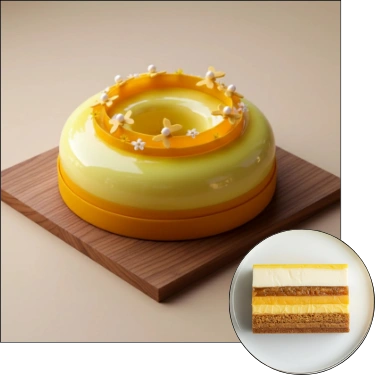
Fresh 5-Layer Lemon Entremet.

A vibrant 5-Layer Lemon Entremet featuring almond caramel crunch, silky lemon ganache, bright lemon curd, almond-lemon praliné, and airy lemon mousse, wrapped in a glossy yellow mirror glaze and decorated with chocolate ribbons and butterflies. A fresh, summery dessert bursting with citrus flavor.

Servings: 10 people

Target Mold Size: 16 cm diameter pastry ring (Internal Insert), 18 cm diameter silicone mold (Outer Mousse).

DAY ONE: Component Preparation and Internal Insert

1) Biscuit Base

IngredientsWeight (g)Notes
Digestive biscuits150 g
Butter75 gMelted
Salt0.5 gA pinch

Method (very detailed)

  1. Place the Digestive biscuits in a blender or food processor and blend until you get fine, sandy crumbs with no large pieces.
  2. Melt the butter over medium heat in a small saucepan, then remove from the heat and let it cool slightly.
  3. In a medium bowl, combine the biscuit crumbs with a pinch of salt.
  4. Pour the melted butter over the crumbs and mix until everything is evenly coated.
  5. Place a 16 cm pastry ring on a tray lined with parchment paper. Line the inside of the ring with an acetate strip and the bottom with baking paper.
  6. Transfer the biscuit mixture into the ring and spread it out evenly.
  7. Use the base of a glass to press and compact the crumbs, making sure the surface is fully level and firmly packed to form a stable base.
  8. Place the biscuit base in the freezer while you prepare the next layer.

2) Caramel Crunch with Lemon and Almond

IngredientsWeight (g)Notes
Caster Sugar25 gFor caramelizing
Blanched Roasted Almonds20 gFor caramelizing and chopping
Caramel Chocolate65 gMelted
Biscoff Cream35 g
Feuilletine40 g
Salt0.5 gA pinch
Lemon Zest5 gAbout 1 teaspoon, freshly grated

Method (very detailed)

  1. Prepare the almonds: If your almonds are not roasted, blanch and then roast them in the oven at 175 degrees C for 5 to 7 minutes. Let them cool.
  2. Place the caster sugar in a small saucepan and heat over medium heat without stirring until it melts and turns into a golden caramel.
  3. Immediately add the chopped almonds to the caramel and stir quickly to coat them evenly. Pour the caramelized almonds onto a sheet of baking paper and spread them slightly. Allow them to cool completely, then chop finely with a knife.
  4. Finely chop the caramel chocolate and melt it gently in a small saucepan. Remove from the heat once smooth.
  5. Stir in the Biscoff cream until fully combined with the melted chocolate.
  6. Add the finely chopped caramelized almonds, feuilletine, freshly grated lemon zest, and a pinch of salt. Mix carefully with a spatula.
  7. Remove the biscuit base from the freezer. Spread the caramel-almond crunch mixture over the biscuit base in an even layer.
  8. Use a spoon or the bottom of a glass to gently level the surface. Place the cake in the freezer so the crunch layer can set completely before adding the next layer.

3) Lemon and White Chocolate Ganache

IngredientsWeight (g)Notes
White Chocolate185 gFinely chopped
Heavy Cream (35 percent fat)56.7 gAbout 55 ml
Lemon Juice50 gAbout 50 ml

Method (very detailed)

  1. Finely chop the white chocolate and place it in a heatproof bowl.
  2. In a small saucepan, combine the heavy cream and lemon juice. Heat over medium heat until the mixture is almost boiling.
  3. Remove the saucepan from the heat. Pour the hot lemon-cream mixture over the chopped white chocolate.
  4. Using a spatula, stir slowly in the center of the bowl until the ganache becomes smooth, shiny, and fully emulsified.
  5. Transfer the ganache to a plastic jug and blend briefly with an immersion blender to ensure a perfectly smooth texture.
  6. Remove the cake (with the set crunch layer) from the freezer. Pour the lemon and white chocolate ganache over the crunch layer.
  7. Gently tilt or lightly shake the cake ring to help the ganache spread into a perfectly even layer.
  8. Place the cake back in the freezer and let the ganache set completely before adding the lemon curd layer.

4) Lemon Curd

IngredientsWeight (g)Notes
Gelatin Sheet (240 Bloom)0.88 gAbout half a sheet, soaked
Lemon Juice100 gAbout 100 ml
Eggs (whole)75 gAbout 1 and a half eggs
Egg Yolk17 gAbout 1 yolk
Caster Sugar70 g
Butter30 g

Method (very detailed)

  1. Soak the 0.88 g gelatin sheet in cold water for 5 to 10 minutes.
  2. In a small saucepan, whisk together lemon juice, eggs, egg yolk, and caster sugar.
  3. Place the pan over medium heat and cook the mixture, whisking constantly. Bring it just to a gentle boil and continue cooking at a low simmer until the curd thickens and lightly coats the back of a spoon.
  4. Remove the saucepan from the heat and immediately strain the lemon curd through a fine mesh sieve.
  5. While the curd is still hot, squeeze the excess water from the softened gelatin and add it to the strained curd. Stir until the gelatin is fully dissolved.
  6. Add the butter (cut into small cubes) and stir until completely melted and the curd is smooth and glossy. Blend briefly with an immersion blender.
  7. Remove the cake from the freezer. Pour the warm lemon curd over the set ganache layer.
  8. Return the cake to the freezer and allow the lemon curd to set completely before adding the praliné.

5) Almond and Lemon Praliné

IngredientsWeight (g)Notes
Caster Sugar90 gFor caramelizing
Blanched Roasted Almonds90 gFor praliné
Lemon Zest5 gAbout 1 teaspoon

Method (very detailed)

  1. Place the caster sugar in a small saucepan and heat over medium heat until it melts and turns a deep golden caramel.
  2. Immediately add the roasted almonds and stir quickly to coat all the nuts evenly.
  3. Pour the caramelized almonds onto a sheet of parchment paper and spread them out slightly. Allow them to cool completely until the caramel is hard.
  4. Break the caramelized almonds into chunks and place them in a strong food processor. Blend until the mixture turns into a smooth nut butter praliné.
  5. Add the freshly grated lemon zest and blend briefly.
  6. Transfer the almond and lemon praliné to a piping bag.
  7. Remove the cake from the freezer. Pipe an even layer of praliné over the set lemon curd.
  8. Use a palette knife or the back of a spoon to smooth and level the praliné layer.
  9. Place the cake back in the freezer and freeze overnight.

DAY TWO: Mousse Preparation and Assembly

6) Lemon Mousse

IngredientsWeight (g)Notes
Gelatin Sheets (240 Bloom)5.25 g3 sheets, soaked
Lemon Juice100 gAbout 100 ml
Caster Sugar100 g
Heavy Cream (35 percent fat)309 gAbout 300 ml, chilled

Method (very detailed)

  1. Soak the 5.25 g gelatin sheets in cold water for 5 to 10 minutes.
  2. In a small saucepan, combine the lemon juice and caster sugar. Heat until the sugar is dissolved and the mixture is almost boiling.
  3. Squeeze the excess water from the softened gelatin and whisk it into the hot lemon syrup.
  4. Let the mixture cool to lukewarm (about 28 degrees C).
  5. In a separate bowl, whip the heavy cream to soft peaks.
  6. Gently fold the whipped cream into the lukewarm lemon mixture in three additions, using broad, gentle motions to keep the mousse light and airy.
  7. Prepare an 18 cm silicone mold (e.g., Silikomart Universo mold) and line it with a tall acetate collar.
  8. Pour the lemon mousse into the mold, filling it almost to the top. Tap the mold gently to release air bubbles.
  9. Remove the frozen cake insert (Layers 1-5) from the freezer. Carefully place the frozen insert into the lemon mousse, praliné facing downwards, until fully submerged and level with the mousse surface.
  10. Freeze the entire cake overnight, until completely solid and ready for glazing.

DAY THREE: Glazing and Decoration

7) Mirror Glaze

IngredientsWeight (g)Notes
Gelatin Sheets (240 Bloom)10.5 g6 sheets, soaked
White Chocolate150 gFinely chopped
Heavy Cream (35 percent fat)103 gAbout 100 ml
Water50 gAbout 50 ml
Caster Sugar150 g
Glucose Syrup150 g
Food Coloring PasteWhite, yellow, and orange

Method (very detailed)

  1. Soak the 10.5 g gelatin sheets. Chop the white chocolate and place it in a large plastic jug.
  2. In a saucepan, combine the sugar, water, heavy cream, and glucose syrup. Heat until the mixture is almost boiling.
  3. Remove from the heat. Squeeze the excess water from the gelatin and whisk it into the hot mixture.
  4. Pour the hot liquid over the chopped white chocolate. Blend with an immersion blender until smooth, keeping the head submerged.
  5. Add white, yellow, and a touch of orange food coloring paste to achieve a bright yellow shade. Blend again until uniform.
  6. Cover the surface of the glaze with cling film and allow it to cool to 34 degrees C to 35 degrees C.
  7. Remove the fully frozen cake from the freezer and unmold it. Place the cake on a wire rack.
  8. When the glaze reaches the correct temperature, pour it generously over the frozen cake in one smooth motion.
  9. Use two palette knives to gently run around the base of the cake, removing excess glaze.
  10. Carefully transfer the glazed cake onto a cake plate. Let the cake thaw in the refrigerator for about 6 hours.

8) Chocolate Ribbons and Chocolate Butterflies

MaterialsWeight (g)Notes
White Chocolate300 gTempered, colored yellow
DecorationSmall butterfly cookie cutter (approx. 2 cm)
White Shimmer Pearls5 gFor butterfly bodies
White FlowersFor garnish
Glucose Syrup5 gFor attaching flowers

Chocolate Decoration Dimensions:

ElementDimensionsDiameter
Ribbon 1 (Around cake)2 cm x 59 cm18 cm
Ribbon 2 (Around cake)3 cm x 59 cm18 cm
Ribbon 1 (On top)14 cm x 45 cmApprox 11 cm
Ribbon 2 (On top)12 cm x 39 cmApprox 9 cm

Method (outline)

  1. Temper Chocolate: Temper the 300 g white chocolate. Color most of it with yellow food coloring powder.
  2. Ribbons: Spread the tempered chocolate onto acetate sheets. Allow to partially set, then cut to the specified sizes and shape them around cold pastry rings.
  3. Butterflies: Pour a portion of the tempered, yellow-colored chocolate thin between two acetate sheets. Cut out butterfly shapes (2 cm) while the chocolate is still slightly soft. Create the butterfly body by placing a small dot of melted chocolate onto a white shimmer pearl and pressing it onto the center of each butterfly.

9) Final Assembly and Decoration

Method (very detailed)

  1. Ensure the glazed cake is fully thawed and chilled.
  2. Take the widest chocolate ribbon (3 cm x 59 cm) and place it around the side of the cake.
  3. Take the second ribbon (2 cm x 59 cm) and place it around the cake, slightly overlapping the first. Fasten the ends with a little melted chocolate.
  4. Place the largest ribbon for the top (14 cm x 45 cm) in a ring on the top of the cake. Place the smaller top ribbon (12 cm x 39 cm) inside the larger one.
  5. Attach the chocolate butterflies around the top ribbons using small dabs of melted chocolate.
  6. Decorate the cake with white flowers, attaching them carefully using small dots of glucose syrup.
  7. Slice with a hot, clean knife to reveal the internal layers (biscuit, crunch, ganache, curd, praliné, and mousse).
Leave a Reply

Your email address will not be published. Required fields are marked *