
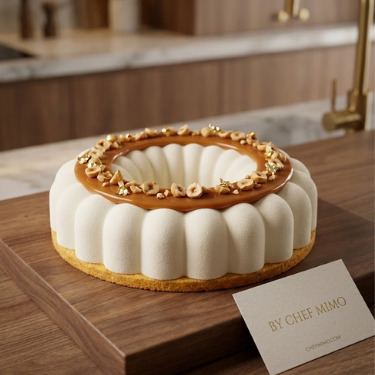
Entremets Vanille & Gianduja – A Creamy Dream of Hazelnut and Madagascar Vanilla
A Creamy Dream of Turin: Introduction to the Vanilla & Gianduja Entremet
While chocolate is often the star of pastry, Gianduja—the Italian invention blending chocolate with hazelnut paste—offers a softer, nuttier, and more sophisticated profile. This Entremets Vanille & Gianduja is a study in elegance, pairing the toasted warmth of hazelnuts with the floral sweetness of Madagascar Vanilla.This dessert is built on contrast. You have the shattering crunch of the Gianduja Crunch base, the chewy, airy texture of the Almond-Hazelnut Dacquoise, the density of the Gianduja Crémeux, and the cloud-like lightness of the Vanilla Mousse. The finish is not a glaze, but a stunning piped decoration using a Vanilla Whipped Cream and a petal tip, creating a ruffle effect that mimics a flower.Why make this? It is the perfect "Bridge Dessert"—ideal for Easter (with the nut/chocolate theme) or elegant dinners. It teaches the art of Mousse-Based Assembly over two days (J-1 strategy) and the precise technique of Dacquoise Baking, ensuring the nut meringue remains chewy rather than dry.Ingredients
Gianduja Crémeux (Day -1)
- 80 g liquid cream
- 40 g milk
- 1 gelatin sheet 2g
- 80 g Gianduja
- + Almond-Hazelnut Praliné for swirl
Gianduja Crunch (Day -1)
- 80 g Gianduja
- 25 g crêpe dentelle
- 25 g crushed sablé biscuits
Almond-Hazelnut Dacquoise (Day -1)
- 2 egg whites
- 20 g granulated sugar
- 40 g icing sugar
- 20 g cornstarch
- 25 g hazelnut flour
- 25 g almond flour
Vanilla Mousse (Day -1)
- 75 g Ivoire white chocolate
- 360 g heavy cream
- 1.5 gelatin sheets
- 1 Madagascar vanilla bean
Vanilla Whipped Cream (Day -1)
- 180 g heavy cream
- 30 g Ivoire white chocolate
- ½ Madagascar vanilla bean
- 0.75 gelatin sheet 1.5g
Mastering Textures and Flavors📗 Download your PDF now!
Instructions
Gianduja Crémeux – Day -1
- Melt Gianduja gently.
- Heat the milk, add rehydrated gelatin, then mix until fully dissolved.
- Pour over Gianduja and blend into a smooth ganache.
- Add cold cream, mix well, and refrigerate overnight.
Gianduja Crunch – Day -1
- Melt Gianduja, then stir in crushed crêpe dentelle and sablé.
- Press the mixture into a 15 cm ring and chill until firm.
Dacquoise – Day -1
- Whip egg whites until foamy, then gradually add sugar to get stiff peaks.
- Fold in sifted dry ingredients gently.
- Pipe two 15 cm discs on baking paper.
- Bake at 180°C for 12 minutes. Cool completely.
Montage Step 1 – Day -1
- Place one dacquoise disc over the crunchy base.
- Whip the Gianduja crémeux and pipe on top.
- Swirl almond-hazelnut praliné over the crémeux.
- Add the second dacquoise disc.
- Freeze the insert for at least 4 hours.
Vanilla Mousse – Day -1
- Heat 80g of cream with vanilla and melted gelatin.
- Pour over white chocolate and stir to form a smooth ganache.
- Add the rest of the cold cream.
- Cover and chill for 1 hour.
- Whip to soft peaks.
Final Assembly – Day -1
- In a 19 cm ring with acetate, pour half the mousse.
- Insert the frozen core (crunch + dacquoise + crémeux).
- Cover with remaining mousse.
- Smooth the top and freeze overnight.
Vanilla Whipped Cream – Day -1
- Melt chocolate in 30g warm cream with gelatin and vanilla.
- Add the rest of the cold cream.
- Cover and refrigerate overnight.
Decoration – Day 0 (Serving Day)
- Whip the vanilla cream to medium peaks.
- Unmold the entremet and pipe with a petal tip (nozzle 104).
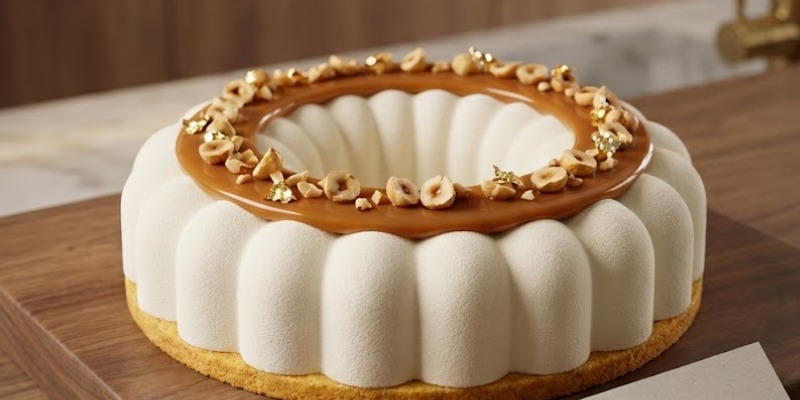
- Decorate with praliné in the center, crushed hazelnuts, crispy pearls, and gold leaves.
- Let thaw in the fridge for 5 hours before serving.
Notes
 The Science of Ingredients: Chemistry of Nuts and Meringue
To balance the fats of the nuts with the aeration of the mousse, we rely on specific mechanics.
1. Gianduja (The Soft Fat System)
The recipe relies heavily on Gianduja (chocolate + hazelnut paste).- The Science: Unlike pure dark chocolate which snaps, Gianduja contains Hazelnut Oil. This oil lowers the melting point of the cocoa butter. In a crémeux or crunch layer, this results in a texture that is "short" and melt-in-the-mouth, never waxy. It allows the flavor to bloom instantly on the tongue because it melts at a lower temperature than body heat.
2. Dacquoise (The Meringue Sponge)
The sponge layer is a Dacquoise, not a Genios.-
The Science: A Dacquoise is a meringue (egg whites + sugar) folded with nut flours. It contains little to no wheat flour.
- Texture: The sugar in the meringue creates a crisp crust during baking, while the nut oils keep the interior moist and chewy.
- Structure: It relies on the air trapped in the albumin proteins of the egg whites. Because there is no gluten network, it is delicate but provides a crucial textural "bite" that soft mousses lack.
3. Praliné Swirl (Texture Contrast)
The insert includes a swirl of pure Praliné.- The Science: Praliné is caramelized nuts ground to a paste. It has a high sugar content and low water activity. When swirled into the fat-based Gianduja Crémeux, it remains distinct. It doesn't dissolve into the cream, providing pockets of intense, gritty sweetness that break up the smoothness of the dairy.
4. Ivoire Chocolate (Vanilla Carrier)
The mousse uses Valrhona Ivoire (White Chocolate).- The Science: Vanilla flavor compounds (vanillin) are fat-soluble. By infusing the vanilla into the hot cream and then emulsifying it with the cocoa butter in the white chocolate, we lock the aroma into the fat. This preserves the floral notes of the Madagascar bean far better than a simple sugar syrup infusion would.
Essential Professional Kitchen Tools
To execute the "Petal" finish and precise layering, you need specific tools.-
Two Ring Sizes (15cm and 19cm)
- Why you need it: The secret to a professional entremet is the hidden insert. You build the core (crunch + dacquoise + crémeux) in the 15cm ring. After freezing, this core is placed inside the 19cm ring. The 2cm gap is filled with mousse, ensuring the sides are perfectly smooth and white.
-
Petal Piping Tip (Nozzle 104)
- Why you need it: For the decoration. A standard round tip creates dots. The #104 Petal Tip has a teardrop shape (wide at one end, narrow at the other). By piping in a zigzag motion, you create the delicate, ruffled "skirt" or flower effect on top of the cake.
-
Acetate Roll (Rhodoïd)
- Why you need it: Lining the 19cm ring with acetate is non-negotiable. It allows you to unmold the frozen mousse cleanly without using a blowtorch (which would melt the sides). It guarantees a glossy, smooth side finish.
-
Immersion Blender
- Why you need it: For the Crémeux and Mousse Base. To ensure the gelatin and fats are perfectly emulsified with the liquid, a stick blender shears the particles together. A whisk might leave small lumps of Gianduja or gelatin.
Expert Tips and Success Hacks
Master the assembly and piping with these professional secrets.1. The "J-1" Schedule (Day Minus One)
You cannot build this cake in one day.-
The Hack:
- Day -1 (Morning): Bake Dacquoise, make Crunch, make Crémeux. Assemble the 15cm "Insert". Freeze.
- Day -1 (Evening): Make Vanilla Mousse. Place frozen insert in 19cm ring. Fill with mousse. Freeze overnight. Make the Vanilla Whipped Cream base (needs to chill).
- Day 0 (Morning): Unmold, whip the top cream, decorate, and thaw.
2. Dacquoise Crispness
Dacquoise can turn soggy if underbaked.- The Hack: Bake until it is golden brown. Unlike a sponge cake that springs back, a dacquoise should feel firm to the touch. Let it cool completely on the paper before peeling it off. If it sticks, it's too wet—put it back in the oven for 2 minutes to dry out.
3. Piping the "Petal" Ruffles
- The Hack: When using the #104 tip, keep the wide end touching the cake and the narrow end facing up/out. Pipe in a gentle back-and-forth motion (like a wave) while rotating the turntable. This creates the undulating ribbon effect. Practice on a plate first!
4. Tempering the Insert
- The Hack: When you press the frozen insert (crunch/dacquoise/crémeux) into the liquid mousse, twist it slightly. This helps eliminate air bubbles trapped underneath the flat crunch layer. Ensure the insert is centered perfectly, or your slices will look lopsided.
5. Handling Gianduja
It melts fast.- The Hack: When making the crunch layer, work quickly. If your hands are warm, the Gianduja will melt, and the mixture will become greasy. If it gets too soft, pop the bowl in the fridge for 5 minutes to firm up before pressing it into the ring.
Frequently Asked Questions (FAQ)
Q1: Can I make my own Gianduja? A: Yes. Blend 100g toasted hazelnuts with 100g powdered sugar until it forms a paste. Melt 100g milk chocolate and mix it with the paste. It won't be as smooth as commercial stone-ground Gianduja, but the flavor will be excellent. Q2: Can I substitute gelatin with agar agar? A: Not easily. Gelatin provides the "melt-in-the-mouth" texture essential for mousse. Agar sets into a firm, brittle jelly that doesn't freeze/thaw well (it weeps water). For a mousse cake like this, gelatin (or fish gelatin) is the only reliable stabilizer. Q3: Why did my mousse separate? A: The white chocolate base was likely too hot when you folded in the whipped cream. The base must be cooled to 25°C-30°C. If it's warm, it melts the fat in the whipped cream, causing it to turn soupy and yellow. Q4: How long does it take to thaw? A: Because the core is dense (crémeux + crunch), it needs about 5 to 6 hours in the fridge to thaw completely. Do not try to speed it up at room temperature, or the mousse will sweat and lose its structure. Q5: Can I freeze the finished cake? A: Yes, before the whipped cream decoration. The mousse-encased cake freezes perfectly for up to 2 weeks. Wrap it tightly. Pipe the top decoration on the day of serving for the freshest texture. Tried this recipe?Let us know how it was!

I’m Chef Mimo, a passionate pastry chef with over 17 years of experience in the world of fine desserts. I specialize in French-style entremets, refined cakes, and creative chocolate work. Pastry is not just my profession—it’s my lifelong passion. Through PastryCrafted.com, I love sharing my recipes, techniques, and inspirations with anyone who dreams of mastering the art of pastry. Whether you’re a curious beginner or a seasoned pro, you’re welcome in my sweet world.