
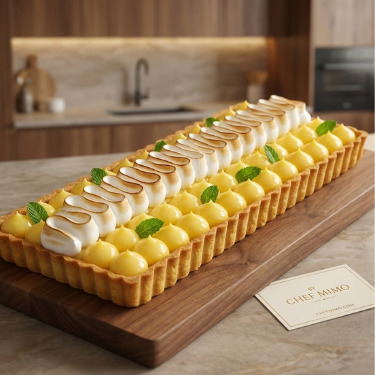
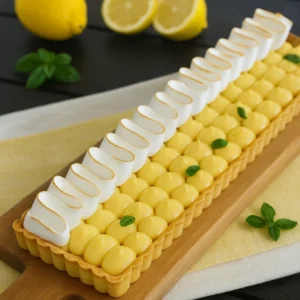
Lemon Basil Meringue Tart – A Modern Citrus Dessert with Creamy Lemon-Basil Filling
A Modern Twist on the Classic Tarte Citron
The Tarte Citron Meringuée is a staple of French pastry, but the Lemon Basil Meringue Tart elevates it to the level of modern gastronomy. By introducing fresh basil, we move beyond simple acidity into the realm of aromatics. The peppery, anise-like notes of basil bridge the gap between the sharp lemon and the sweet almond, creating a flavor profile that is sophisticated and refreshing.This tart is built on four distinct pillars: a crisp Almond Tart Crust, a baked Frangipane layer (which adds richness and protects the crust), a vibrant Lemon Crémeux, and a silky Lemon-Basil Cream. It is crowned with Italian Meringue, piped elegantly to provide a marshmallow-soft contrast to the crisp base.Why master this recipe? It teaches the art of herb infusion in dairy, a technique that can be applied to mint, tarragon, or verbena. It also demonstrates the "baked filling" method (frangipane) vs. the "set filling" method (crémeux), combining both for textural complexity.Ingredients
Lemon-Basil Cream
- 2 ½ gelatin sheets
- 100 ml lemon juice
- 200 g sugar
- 200 g whole eggs approx. 4 eggs
- 160 g soft butter
Fresh basil leaves (to taste)
- Almond Tart Crust
- 75 g soft butter
- 50 g powdered sugar
- 15 g ground almonds
- 1 pinch of salt
- A touch of vanilla
- 130 g flour Type 550 or all-purpose
- 1 egg yolk may be mixed with a little egg white
Almond Frangipane
- 60 g ground almonds
- 60 g soft butter
- 60 g sugar
- ½ beaten egg
Lemon Crémeux
- 100 ml lemon juice
- 1 whole egg
- 1 egg yolk
- 50 g sugar
- 1 gelatin sheet
- 60 g butter
Italian Meringue
- 125 g sugar
- 35 ml water
- 60 g egg whites
- A pinch of salt
Mastering Textures and Flavors📗 Download your PDF now!
Instructions
Lemon-Basil Cream
- Soak the gelatin sheets in cold water.
- In a saucepan, combine lemon juice, 100 g sugar, and basil leaves. Heat gently.
- Whisk the eggs with the remaining 100 g sugar.
- Once the lemon mixture simmers, strain it into the egg mixture while whisking.
- Pour back into the pot and cook gently, stirring constantly, until thickened.
- Remove from heat, add softened gelatin, and let cool slightly.
- When the mixture is around 30°C, blend in soft butter using a stick blender.
- Transfer to a piping bag with a round tip and chill for 3 hours.
Almond Tart Crust
- Cream butter and powdered sugar.
- Add ground almonds, salt, vanilla, egg yolk, and flour. Mix to a smooth dough.
- Wrap in plastic and chill for at least 2 hours.
- Roll out to 3–4 mm thickness and line a rectangular tart mold (approx. 35×11 cm).
- Trim edges clean, freeze for 10 minutes. No need to blind bake.
- Meanwhile, prepare the frangipane.
Almond Frangipane
- Mix all ingredients into a smooth cream.
- Spread over the tart base.
- Bake at 180°C (top/bottom heat) for approx. 20 minutes until golden.
- Let cool completely.
Lemon Crémeux
- Soak gelatin in cold water.
- In a saucepan, combine lemon juice, sugar, whole egg, and egg yolk.
- Heat gently while stirring until thickened (do not exceed 82°C).
- Remove from heat, dissolve gelatin in the mixture.
- Let cool to about 40°C.
- Add butter in chunks and emulsify with a stick blender.
- Spread over the cooled tart base. Chill until set.
Italian Meringue
- In a saucepan, combine sugar and water. Heat to 118°C.
- While heating, start whipping egg whites with a pinch of salt.
- When sugar syrup reaches temp, slowly pour into whipped egg whites while beating.
- Continue to whip until glossy and cooled.
Assembly & Decoration
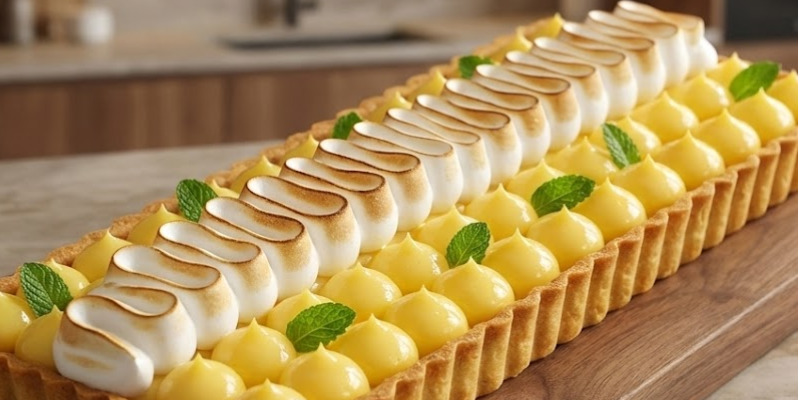
- Pipe chilled lemon-basil cream over the tart in tight dots.
- Pipe Italian meringue on one side using a St. Honoré tip.
- Torch the meringue until lightly golden.
- Garnish with fresh basil leaves and lime zest if desired.
- Chill the tart until ready to serve.
Notes
 The Science of Ingredients: Chemistry of Infusion and Structure
To balance these strong flavors and textures, specific chemical interactions are required.
1. Basil (Volatile Oils)
The recipe infuses fresh basil into the lemon cream.- The Science: Basil contains volatile compounds like estragole and linalool. These compounds are heat-sensitive. If you boil basil for too long, the fresh, peppery notes evaporate, leaving behind a cooked, vegetal taste (like spinach). The key is a gentle infusion (simmering briefly) to extract the aroma without destroying the delicate top notes.
2. Frangipane (The Moisture Buffer)
A layer of almond cream (frangipane) is baked directly into the raw tart shell.- The Science: Lemon fillings are wet. If you pour lemon curd directly onto a baked shell, it can eventually make the crust soggy. Frangipane, being high in fat (butter/almond oil) and egg protein, acts as a hydrophobic barrier. It absorbs some moisture from the toppings but prevents it from seeping into the crisp crust underneath.
3. Italian Meringue (Sugar Syrup Stability)
The recipe uses Italian Meringue (sugar syrup cooked to 118°C poured over whites).- The Science: Unlike French meringue (raw sugar), Italian meringue is partially cooked by the 118°C syrup. This denatures the egg proteins (ovalbumin), creating a foam structure that is incredibly stable and dense. It is safe to eat without further baking and holds its shape indefinitely, unlike French meringue which can weep or deflate over time.
4. Lemon pH & Gelatin
Both the Crémeux and the Basil Cream use gelatin.- The Science: Lemon juice has a low pH (high acidity). Acid weakens the gelling power of gelatin over time. To compensate, citrus-based creams often require a slightly higher ratio of gelatin or a precise setting temperature. The addition of butter (emulsified) also helps set the cream, adding a luxurious mouthfeel that gelatin alone cannot provide.
Essential Professional Kitchen Tools
The "Modern" look requires precision tools.-
Rectangular Tart Ring (35x11 cm)
- Why you need it: The modern aesthetic favors elongated, rectangular tarts over round ones. This shape allows for precise slicing and elegant piping patterns that flow linearly.
-
St. Honoré Piping Tip
- Why you need it: The teardrop shape of the St. Honoré nozzle allows you to pipe the signature "zigzag" or "overlapping tear" pattern seen on high-end pastries. It creates volume and shadow play that a simple round tip cannot achieve.
-
Immersion Blender (Stick Blender)
- Why you need it: For the Lemon-Basil Cream and Crémeux. Adding butter to a warm liquid requires emulsification. A whisk might leave small butter pockets; an immersion blender shears the fat globules into microscopic sizes, ensuring a perfectly smooth, glossy cream.
-
Digital Thermometer
- Why you need it: Essential for the Italian Meringue (syrup must hit 118°C) and the Crémeux (eggs must not exceed 82°C). Visual cues are unreliable for sugar syrups.
Expert Tips and Success Hacks
Achieve the sharp edges and perfect piping of a boutique bakery.1. The "No Blind Bake" Method
This recipe bakes the raw dough and frangipane together.- The Hack: To ensure the bottom cooks through without blind baking, freeze the lined tart shell for 10 minutes before filling with frangipane. Then bake in the lower third of the oven. The direct heat from the bottom element will crisp the pastry at the same rate the frangipane cooks.
2. Emulsifying at 40°C
Temperature matters when adding butter to the crémeux.- The Hack: If you add butter when the lemon curd is hot (>60°C), the butter melts into oil, making the cream greasy. If too cold (<30°C), it won't incorporate. Wait for 40°C (104°F)—the butter will soften and emulsify into a creamy, opaque mayonnaise-like texture.
3. Piping the St. Honoré Pattern
- The Hack: Hold the piping bag with the "slit" of the St. Honoré tip facing up. Pipe using a rhythmic "pressure-release-pull" motion. Squeeze to build the bulb of the meringue, stop squeezing, and pull sharply to create the tail. Overlap the next bulb slightly over the previous tail.
4. Basil Color Preservation
Basil browns quickly (oxidizes).- The Hack: To keep the infusion vibrant, you can blanch the basil leaves in boiling water for 5 seconds and shock them in ice water before adding them to the lemon juice. This locks in the chlorophyll, ensuring the flavor is fresh and the color (if you blend any in) stays green.
5. Torching Technique
Don't burn the sugar.- The Hack: Use a kitchen blowtorch on a low flame. Keep the flame moving constantly; do not hold it in one spot. You want to caramelize the sugar peaks to a golden brown, not black. The heat also helps form a slight crust on the meringue, adding texture.
Frequently Asked Questions (FAQ)
Q1: Can I use lime instead of lemon? A: Absolutely. Lime and Basil is an even more classic pairing than lemon. The acidity is slightly sharper, so you might want to increase the sugar by 10%. Yuzu is another excellent, albeit expensive, alternative. Q2: Can I make this ahead of time? A:- Tart Base: Bake up to 2 days ahead (store airtight).
- Fillings: The Crémeux and Basil Cream need to set, so making them a day ahead is ideal.
- Assembly: Pipe the meringue on the day of serving. Humidity in the fridge can make meringue sticky after 24 hours.
Tried this recipe?Let us know how it was!

I’m Chef Mimo, a passionate pastry chef with over 17 years of experience in the world of fine desserts. I specialize in French-style entremets, refined cakes, and creative chocolate work. Pastry is not just my profession—it’s my lifelong passion. Through PastryCrafted.com, I love sharing my recipes, techniques, and inspirations with anyone who dreams of mastering the art of pastry. Whether you’re a curious beginner or a seasoned pro, you’re welcome in my sweet world.