
Lemon Praline Entremets – A Refined Symphony of Citrus and Crunch
A Symphony of Acidity and Earthiness: Introduction to Lemon Praline
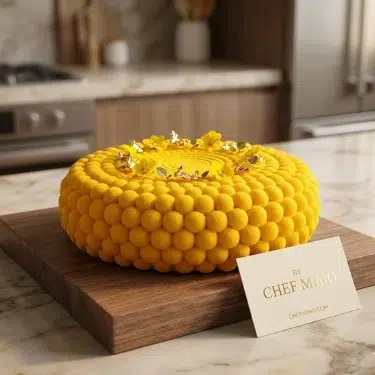
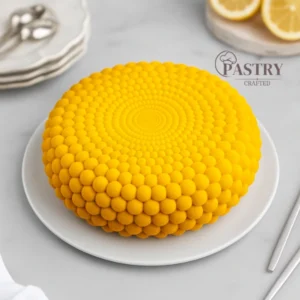
In the universe of flavor pairings, few combinations are as sophisticated as citrus and hazelnut. While lemon meringue is a classic, the Lemon Praline Entremets takes that concept and grounds it with the earthy, roasted depth of caramelized nuts. This dessert is a study in contrast: the sharp, high-pitched acidity of the lemon gel and mousse against the deep, bass notes of the sweet praliné crémeux and biscuit.This entremets features four distinct textures: the sandy crunch of the Lemon Streusel base, the dense chew of the Praliné Biscuit, the silky richness of the Crémeux, and the airy lightness of the Lemon Mousse. To finish, it bypasses the traditional shiny glaze for a Velvet Spray (Flocage)—a technique that coats the cake in a thin layer of crystallized chocolate, giving it a modern, matte texture resembling fabric.Why make this? It solves the problem of "palate fatigue." A pure chocolate cake can be too heavy; a pure lemon tart can be too sharp. This recipe oscillates between the two, offering a refreshing cleanse with every bite of lemon, followed immediately by the comforting richness of praliné. It is a dessert that looks minimalist but tastes maximalist.Ingredients
🍋 Lemon Streusel
- 40 g cold butter
- 40 g brown sugar
- 40 g flour T55 or all-purpose
- 45 g almond powder
- 1 g salt
- 1 egg yolk
- Zest of 1 lemon
🍰 Praline Biscuit
- 80 g almond powder or almond-hazelnut mix
- 20 g flour
- 60 g powdered sugar
- 100 g egg whites
- 50 g granulated sugar
- 30 g praliné
💧 Lemon Gel
- 150 g lemon juice
- 20 g sugar
- 3 g gelatin
🥜 Praline Cremieux
- 100 g heavy cream 35% fat
- 150 g praliné
- 2 g gelatin
🍋 Lemon Mousse
- Zest and juice of 2 lemons
- 3 eggs
- 50 g butter cubed
- 60 g sugar
- 6 g gelatin
- 250 g whipping cream 35%
🎨 Velvet Spray
- 170 g white chocolate
- 100 g cocoa butter
- Yellow and orange fat-soluble food coloring
Mastering Textures and Flavors📗 Download your PDF now!
Instructions
Lemon Streusel
- Preheat oven to 150°C (302°F).
- In a food processor, blend all dry ingredients.
- Add egg yolk and mix again.
- Roll dough between two sheets of parchment to 7 mm thick.
- Cut out a 15 cm circle and bake for 15 minutes. Let cool.
Praline Biscuit
- Preheat oven to 170°C (338°F).
- Line a tray with parchment and place a 16 cm ring on it.
- Whip egg whites to foam, gradually add sugar to form stiff meringue.
- Fold in praliné and dry ingredients using a spatula.
- Pour into the ring and bake for 15 minutes. Freeze after cooling.
- Lemon Gel
- Heat lemon juice and sugar to a boil.
- Remove from heat and stir in rehydrated gelatin.
- Pour into a flat dish and chill for at least 1 hour.
Praline Cremieux
- Bring cream to a boil.
- Add soaked gelatin and mix.
- Stir in praliné and blend until smooth.
Insert Assembly
- Line a 15 cm ring with plastic wrap and acetate.
- Place the lemon streusel at the bottom.
- Pour praliné crémeux on top.
- Add the praliné biscuit and press lightly.
- Pour in lemon gel.
- Freeze the entire insert for at least 12 hours.
Lemon Mousse
- In a saucepan, whisk together eggs, sugar, lemon zest and juice.
- Add butter and cook while whisking constantly until it boils.
- Remove from heat, add gelatin, and stir to dissolve.
- Cover with plastic wrap and refrigerate until the cream reaches 28°C (82°F).
- Blend with an immersion blender for a smooth texture.
- Whip the cream to soft peaks and fold it into the lemon base in 3 stages.
- Final Assembly
- Fill two-thirds of the mold with lemon mousse.
- Insert the frozen core and press gently to bring mousse up the sides.
- Smooth the surface and freeze for at least 24 hours.
Velvet Spray
- Melt white chocolate and cocoa butter to 45°C (113°F).
- Divide and color with yellow and orange coloring.
- Strain and pour one color into the spray gun.
- Unmold the frozen entremets, place on a tray or rack.
- Spray with light upward strokes for a fine velvet finish.
- Switch colors and repeat for the lower part.
- Let defrost in the fridge for 4 hours before serving.
Notes
 The Science of Ingredients: The Alchemy of Velvet and Zest
Understanding the specific chemical roles of these ingredients will help you master the delicate textures of this entremets.
1. Praliné Paste (The Emulsified Nut)
The soul of the biscuit and crémeux is "Praliné"—nuts roasted with sugar until caramelized, then ground into a paste.- The Science: Praliné acts as a fat paste. Unlike whole nuts, the grinding process releases the nut oils, creating a suspension of sugar crystals in oil. When added to the Crémeux, this oil creates a denser, smoother emulsion than dairy fat alone could achieve. In the Biscuit, the high sugar content of the praliné adds a "chewy" texture (hygroscopy) that keeps the sponge moist even after freezing.
2. Cocoa Butter (The Velvet Mechanic)
The "Velvet Spray" is a mix of white chocolate and pure cocoa butter.- The Science: Cocoa butter has a unique crystallization pattern. When the warm mixture (45°C) is sprayed through a nozzle onto the frozen cake (-18°C), the cocoa butter undergoes "thermal shock." It solidifies instantly upon contact, forming microscopic beads or crystals rather than a flat sheet. These millions of tiny frozen droplets diffract light, creating the matte, fuzzy "velvet" appearance. If you used regular butter or oil, it would simply look greasy.
3. Lemon Acid (Protein Denaturation)
The mousse begins with a lemon curd base.- The Science: Lemon juice contains citric acid. When cooked with eggs, the acid lowers the coagulation temperature of the egg proteins, causing them to set faster. This creates a thick, creamy curd without needing starch. However, this acidity can destabilize the whipped cream added later. This is why the gelatin is crucial—it stabilizes the acidic mixture so it can support the structure of the aerated cream.
4. Gelatin (The Stabilizer)
This recipe uses gelatin in three different layers: gel, crémeux, and mousse.- The Science: In the Lemon Gel, gelatin provides a "brittle" set that melts in the mouth, releasing the juice instantly. If you used pectin or starch, the texture would be more jam-like or gummy. In the Mousse, gelatin prevents the air bubbles (whipped into the cream) from collapsing under the weight of the cake.
Essential Professional Kitchen Tools
To achieve the sharp layers and velvet finish, specific tools are non-negotiable.-
Velvet Spray Gun (or Aerosol Can)
- Why you need it: To achieve the velvet effect, you need to atomize the chocolate. You can buy pre-made velvet spray cans (easiest for home cooks) or use an electric paint sprayer (dedicated to food) if you are mixing your own chocolate/cocoa butter ratio. A brush or ladle cannot create this texture.
-
Digital Thermometer
-
Why you need it: Crucial for two steps:
- Mousse Assembly: The lemon base must be cooled to 28°C before folding in the whipped cream. If it's 35°C, it will melt the cream. If it's 20°C, the gelatin will set into rubbery lumps before you can mix it.
- Velvet Spray: The mixture must be sprayed at 45°C. Too cool, and it clogs the gun; too hot, and it melts the cake surface.
-
Why you need it: Crucial for two steps:
-
Acetate Roll
- Why you need it: For lining the ring molds. Acetate ensures a perfectly smooth side when unmolding. Since this cake is sprayed, any imperfection or wrinkle on the side of the mousse will be highlighted by the velvet texture.
-
Immersion Blender
- Why you need it: For the Lemon Mousse base and Crémeux. Blending ensures the gelatin is perfectly dispersed and the fats are emulsified, resulting in a mouthfeel that is silky, not grainy.
Expert Tips and Success Hacks
Here are the secrets to getting those perfect, clean layers seen in pâtisserie windows.1. The "Hard Freeze" for Velvet
You cannot spray a semi-soft cake.- The Hack: The entremets must be frozen to at least -18°C (standard freezer temp) for at least 24 hours. The "thermal shock" relies on this extreme cold. If the cake is only partially frozen, the cocoa butter spray will slide off or look wet instead of velvety.
2. The Streusel Waterproofing
Streusel can get soggy sitting under mousse.- The Hack: After baking the streusel disc, you can brush it with a thin layer of melted cocoa butter or white chocolate. This acts as a moisture barrier, keeping the base crunchy for days, even when defrosted.
3. The Three-Stage Fold
When making the mousse, don't dump all the whipped cream in at once.-
The Hack:
- Sacrifice: Whisk 1/3 of the whipped cream vigorously into the lemon base to loosen the texture.
- Fold: Gently fold in the second 1/3 to retain air.
- Finish: Fold in the final 1/3 with extreme care. This gradient approach prevents the heavy base from deflating the light cream.
4. Centering the Insert
Nothing is sadder than cutting a cake and finding the filling off to the side.- The Hack: When you push the frozen insert (Biscuit + Crémeux + Gel) into the mousse, twist it slightly back and forth as you press down. This twisting motion helps center it and pushes air bubbles out from underneath.
5. Cleaning the Spray Nozzle
Velvet spray clogs instantly as it cools.- The Hack: If using a spray gun, keep a heat gun or hairdryer nearby. If the spray starts seeking "spitting" large droplets instead of a fine mist, blast the nozzle with hot air for 5 seconds to melt the solidified cocoa butter inside the tip.
Frequently Asked Questions (FAQ)
Q1: Can I use a Mirror Glaze instead of Velvet Spray? A: Absolutely. If you don't have a spray gun, a yellow mirror glaze (like the one in our previous recipe) works perfectly. The flavor profile will be slightly sweeter due to the glaze's sugar content, whereas the velvet spray is very thin and neutral, but both are beautiful. Q2: Can I make the Praliné Paste at home? A: Yes. Roast 150g of hazelnuts/almonds. Caramelize 100g of sugar to an amber color, pour onto a mat to cool. Break the caramel brittle and blend it with the nuts in a food processor. Keep blending past the powder stage until the oils release and it becomes a liquid paste. Q3: How long does it take to defrost? A: Because this cake is mousse-based, it needs to thaw slowly. Place the finished (sprayed) cake in the fridge for at least 4 to 6 hours before serving. Do not defrost at room temperature, or the velvet spray may crack and the mousse may slump. Q4: Can I substitute the gelatin? A: For the mousse and crémeux, gelatin is the best stabilizer. Agar-agar is risky here because it sets at 40°C, which would make folding in the whipped cream (which melts at 30°C) impossible without creating lumps. Stick to gelatin (sheet or powder) for the correct texture. Q5: Why did my Velvet Spray crack? A: This usually happens if the spray layer is too thick. You only need a very fine mist to cover the color. If you spray too much, the shell becomes thick and rigid. When the cake thaws and expands slightly (or when you cut it), the hard shell cracks. Use sweeping motions and stop as soon as it's covered. Tried this recipe?Let us know how it was!

I’m Chef Mimo, a passionate pastry chef with over 17 years of experience in the world of fine desserts. I specialize in French-style entremets, refined cakes, and creative chocolate work. Pastry is not just my profession—it’s my lifelong passion. Through PastryCrafted.com, I love sharing my recipes, techniques, and inspirations with anyone who dreams of mastering the art of pastry. Whether you’re a curious beginner or a seasoned pro, you’re welcome in my sweet world.