
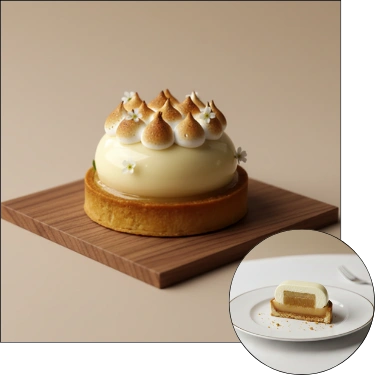
An iconic recreation of the classic Lemon Tart, featuring layers of Almond Caramel Ganache, tart Lemon Broken Gel, creamy White Chocolate Mousse, and a baked Pâte Sablée shell.

Yields: 6 Tarts
 Target Molds: 6 cm diameter tart rings (for Sablée), 6.5 cm diameter silicone molds (for Mousse), 4 cm diameter silicone insert molds (for Ganache/Gel)
DAY ONE: Component Preparation (Insert Core)
1. Almond Caramel Ganache (Insert Base)
| Ingredient | Weight (g) | Notes |
|---|---|---|
| White Chocolate (30-35% cocoa butter) | 35 g | Finely chopped |
| Caramel Chocolate (30%) | 35 g | Finely chopped |
| Almond Paste (Marzipan-like consistency) | 70 g | High-quality, room temperature |
| Heavy Cream (35% fat) | 62 g | |
| Fine Sea Salt | Pinch |
Method
- Melt Base: Gently melt the white chocolate, caramel chocolate, and almond paste together in a saucepan until fully combined and smooth. Transfer the mixture to a bowl and reserve.
- Infuse Cream: Heat the heavy cream in a separate saucepan until it is steaming and almost boiling (approx 90°C).
- Emulsify: Pour the hot cream over the chocolate/almond mixture. Stir firmly in the center with a rubber spatula until the ganache is glossy and homogenous.
- Blend and Pipe: Pour the ganache into a plastic jug. Add the sea salt and blend with an immersion blender until perfectly smooth. Transfer the ganache to a piping bag.
- Fill Inserts: Fill six 4 cm diameter silicone insert molds approximately 75% full (3/4 capacity) with the ganache.
- Chill: Place the mold in the freezer while preparing the next layer. The filling must set before the gel is added.
2. Lemon Broken Gel (Insert Topping)
| Ingredient | Weight (g) | Notes |
|---|---|---|
| Lemon Juice (freshly strained) | 103 g | |
| Caster Sugar | 120 g | |
| Agar Agar Powder | 6.75 g |
Method
- Hydrate and Boil: Combine the lemon juice, caster sugar, and agar agar in a small saucepan. Bring the mixture to a rolling boil, whisking constantly for 1 to 2 minutes to fully activate the agar agar.
- Set: Pour the hot gel into a shallow plastic container. Chill in the refrigerator for a minimum of 5 hours until completely firm and cold.
- Blend and Pipe: Once set, transfer the firm gel to a tall plastic pitcher. Use an immersion blender to process the gel until it becomes a smooth, lump-free fluid (broken gel). Transfer the broken gel to a piping bag.
- Complete Inserts: Fill the remaining space in the 4 cm insert molds (on top of the ganache) with the lemon broken gel.
- Freeze: Freeze the cake inserts overnight until completely solid.
DAY TWO: Mousse Preparation
3. Lemon & White Chocolate Mousse
| Ingredient | Weight (g) | Notes |
|---|---|---|
| Gelatin Sheet (240 Bloom) | 3.5 g | 2 sheets, Extra Gold, bloomed |
| White Chocolate (30-35% cocoa butter) | 160 g | Finely chopped |
| Lemon Juice (freshly strained) | 31 g | |
| Heavy Cream (for heating) | 134 g | |
| Heavy Cream (for whipping) | 196 g | Chilled |
Method
- Bloom and Melt: Soak the gelatin in cold water for 5 to 10 minutes. Gently melt the white chocolate and reserve it in a large mixing bowl.
- Infuse Cream: Heat the 134 g of heavy cream and the lemon juice in a saucepan almost to a boil. Remove from heat, squeeze the excess water from the bloomed gelatin, and whisk it into the hot cream until fully dissolved.
- Emulsify Base: Pour the hot cream mixture over the melted white chocolate while stirring gently from the center outwards with a rubber spatula until the base is glossy and smooth.
- Cool: Allow the base to cool until lukewarm (approx 28°C).
- Whip and Fold: Whip the 196 g of chilled heavy cream to soft peaks. Gently fold the whipped cream into the lukewarm chocolate mixture in three additions, maintaining the airy structure of the mousse.
- Set Mousse: Pour the chocolate mousse into eight 6.5 cm diameter silicone molds (e.g., Silikomart Stone 85), filling each mold approximately 80% full.
- Partial Set: If the mousse consistency is very liquid, place the molds in the refrigerator until they have partially set (when a spoon dipped in the surface leaves a soft peak). This prevents the insert from sinking.
- Insert Core: Retrieve the frozen 4 cm ganache/gel inserts from the freezer and demold them. Place one insert into the center of each mousse mold, with the Lemon Broken Gel facing downwards.
- Freeze: Freeze the assembled cakes overnight until completely solid.
DAY THREE: Assembly & Finishing
4. Pâte Sablée (Tart Shells)
| Ingredient | Weight (g) | Notes |
|---|---|---|
| All-Purpose Flour | 190 g | |
| Almond Flour | 40 g | |
| Icing Sugar (powdered) | 75 g | Sifted |
| Cold Unsalted Butter | 115 g | Cubed |
| Large Egg (Whole) | 37.5 g | Approximately 3/4 of a large egg |
| Fine Sea Salt | Pinch |
Method
- Combine Dry Ingredients: In a bowl, mix the icing sugar, all-purpose flour, almond flour, and salt.
- Cut in Butter: Add the cold cubed butter and mix/knead until the butter is fully incorporated and you no longer have large pieces of butter, resulting in a sandy texture.
- Add Egg: Add the 37.5 g of egg and knead the dough briefly until it just comes together. Do not overwork.
- Chill and Shape: Roll out the dough evenly between two sheets of parchment paper. Chill in the refrigerator for 1 to 2 hours (or 30 minutes in the freezer) until firm.
- Bake Shells: Cut out 6 tart bottoms and sides to fit the 6 cm diameter tart rings. Line the rings with the dough and place them on a perforated baking mat (AirMat) or parchment paper. Prick the bottom of the dough several times with a fork.
- Bake: Bake the tart shells at 175°C for 12 to 14 minutes until golden brown.
- Cool: Allow the shells to cool completely on a cooling rack.
5. Lemon Caramel Crunch (Tart Base)
| Ingredient | Weight (g) | Notes |
|---|---|---|
| Caramel Chocolate (30%) | 35 g | Melted |
| Creamy Biscoff Spread | 11 g | |
| Feuilletine Flakes | 45 g | |
| Fine Sea Salt | Pinch | |
| Lemon Zest | 0.5 g | Finely grated |
Method
- Melt and Combine: Gently melt the caramel chocolate in a small saucepan and set aside. Stir in the feuilletine flakes, Biscoff cream, lemon zest, and salt until evenly combined.
- Fill Shells: Spread a layer of the crunch mixture into the base of the 6 cooled tart shells. Aim for approximately 18 g of crunch per tart.
- Set: Flatten the layer with a spoon. Place the tarts on a tray or cutting board in the refrigerator to allow the crunch layer to set firm.
6. Lemon Curd (Tart Filling)
| Ingredient | Weight (g) | Notes |
|---|---|---|
| Gelatin Sheet (240 Bloom) | 1.75 g | 1 sheet, Extra Gold, bloomed |
| Large Egg (Whole) | 55 g | Approximately 1.1 eggs |
| Large Egg Yolks | 45 g | Approximately 2 1/4 yolks, medium size |
| Lemon Juice (freshly strained) | 180 g | |
| Caster Sugar | 175 g | |
| Cold Unsalted Butter | 50 g | Cubed |
Method
- Bloom Gelatin: Soak the gelatin in cold water for 5 to 10 minutes.
- Combine and Heat: In a large pot, whisk together the lemon juice, whole egg, egg yolks, and sugar. Slowly heat the mixture, whisking constantly, until it reaches the boiling point and begins to thicken (custard consistency). Simmer for a few minutes while whisking until the cream visibly thickens.
- Finish Curd: Remove the pan from the heat. Whisk in the cold cubed butter until fully incorporated and smooth. Squeeze the excess water from the bloomed gelatin and whisk it into the curd until dissolved.
- Strain and Blend: Strain the lemon curd through a fine mesh strainer to ensure a silky texture. Blend briefly with an immersion blender to ensure it is completely smooth.
- Cool and Fill: Allow the curd to cool on the workbench until it is no longer hot.
- Fill Tarts: Fill the crunch-lined tart shells with the cooled lemon curd.
- Set: Place the tarts in the refrigerator to allow the lemon curd to set completely.
7. Transparent Glaze (Glaçage Neutre)
| Ingredient | Weight (g) | Notes |
|---|---|---|
| Gelatin Sheet (240 Bloom) | 11.4 g | Approximately 6 1/2 sheets, Extra Gold, bloomed |
| Water | 70 g | |
| Caster Sugar | 140 g | |
| Glucose Syrup | 215 g | |
| Lemon Juice (freshly strained) | 20 g | Sifted |
Method
- Bloom Gelatin: Soak the gelatin in cold water.
- Prepare Syrup: In a saucepan, combine the sugar, water, and glucose syrup. Heat to a precise temperature of 105°C without stirring.
- Combine: Remove the saucepan from the heat. Add the 20 g of strained lemon juice. Squeeze the excess water from the bloomed gelatin and whisk it into the mixture until dissolved.
- Cool and Temper: Strain the glaze into a tall plastic pitcher. Cover the surface directly with cling film to prevent a skin and remove air bubbles. Cool the glaze down to its working temperature of 35°C.
- Glaze Cakes: Retrieve the frozen 6.5 cm mousse cakes from the freezer. Place them on a baking cooling rack over a tray. Pour the glaze evenly over the frozen cakes.
- Place on Tarts: Use two palette knives to remove the glaze excess from the bottom of the cakes. Immediately place one glazed mousse cake on top of the set lemon curd in each tart shell.
- Thaw: Allow the finished tarts to thaw in the refrigerator for approximately 2 to 3 hours before serving.
8. Italian Meringue (Topping)
| Ingredient | Weight (g) | Notes |
|---|---|---|
| Caster Sugar (Syrup) | 100 g | |
| Glucose Syrup | 55 g | |
| Water | 40 g | |
| Egg Whites | 65 g | (Meringue Base) |
| Caster Sugar (Meringue) | 19 g | Approximately 1.5 tbsp |
Method
- Prepare Meringue Base: Whisk the egg whites until foamy. Gradually add the 19 g of sugar and continue whisking until stiff, glossy soft peaks form.
- Prepare Syrup: In a small pot, combine the 100 g of sugar, glucose syrup, and water. Heat to a precise temperature of 118°C (244°F). Remove immediately from heat.
- Combine: With the mixer running, slowly and steadily stream the 118°C hot syrup into the egg whites. Continue whisking on high speed until the meringue is firm, glossy, and has cooled completely.
- Pipe and Torch: Transfer the meringue to a piping bag fitted with a large round tip (e.g., 24 mm). Pipe a dome of meringue on top of each glazed mousse cake.
- Use a blowtorch to gently toast the meringue on one side for color and flavor. Be careful not to burn the underlying glazed cake.
9. Chocolate Ribbons & Decoration
| Material | Weight (g) | Notes |
|---|---|---|
| White Chocolate | 200 g | Tempered |
| Acetate Sheet | – | 8 cm x 29 cm (for swirls) |
| Chocolate Scraper | – | With 0.5 cm narrow grooves |
| Flowers and Green Leafs | – | For final garnish |
Method
- Prepare Swirls: Temper the 200 g of white chocolate. Spread it thinly onto the 8 cm x 29 cm acetate sheet. Use a grooved chocolate scraper to create lines/swirls. Allow the chocolate to set until flexible, then wrap it around a form to set the curve. Once hard, carefully break the chocolate into 6 pieces suitable for decorating the tarts.
- Final Garnish: Decorate each meringue-topped tart with the prepared chocolate swirl, flowers, and green leaves.

I’m Chef Mimo, a passionate pastry chef with over 17 years of experience in the world of fine desserts. I specialize in French-style entremets, refined cakes, and creative chocolate work. Pastry is not just my profession—it’s my lifelong passion. Through PastryCrafted.com, I love sharing my recipes, techniques, and inspirations with anyone who dreams of mastering the art of pastry. Whether you’re a curious beginner or a seasoned pro, you’re welcome in my sweet world.