
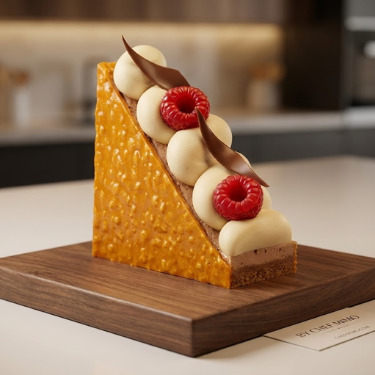
Mille-Feuille Chocolate Noir Modern with Raspberry
The Architecture of Crunch: Introduction to the Modern Mille-Feuille
The Mille-Feuille (literally "Thousand Leaves") is the ultimate test of a pastry chef's patience. While the classic version pairs vanilla cream with fondant icing, this Modern Chocolate Noir interpretation strips away the excess sweetness to focus on texture and intensity. It features razor-sharp layers of Caramelized Puff Pastry, a rich Maracaibo 65% Chocolate Cream, and a tart Raspberry Jelly.What makes this recipe "modern"? It incorporates Inulin, a functional fiber that allows us to reduce sugar and fat while maintaining a creamy, full-bodied mouthfeel. It also utilizes Pectin NH, allowing for a fruit texture that is set yet melting. The finish is not a heavy glaze, but a sophisticated "brûlée" top and a precise St. Honoré piping.Why master this? It is a lesson in Lamination (creating the layers), Emulsion (perfect creams), and Precision Cutting. Unlike a cake that hides flaws under frosting, a mille-feuille exposes every layer. It is pastry architecture in its purest form.Ingredients
Puff Pastry Dough
- 550 g water 19.4 oz
- 1075 g pastry flour type 400 37.92 oz
- 25 g salt 0.88 oz
- 10 g white wine vinegar 0.35 oz
- 1000 g butter for lamination 35.27 oz
Vanilla Pastry Cream
- 500 g whole milk 3.5% (17.64 oz)
- 500 g heavy cream 35% (17.64 oz)
- Seeds from 1 Bourbon vanilla bean approx. 4 g
- 140 g pasteurized liquid egg yolk 4.94 oz
- 140 g granulated sugar 4.94 oz
- 60 g inulin HSI 2.12 oz
- 60 g vanilla custard powder 2.12 oz
- 22 g powdered gelatin 200 Bloom (0.78 oz)
- 100 g cold water for blooming gelatin 3.53 oz
- 1200 g cold heavy cream 35% (42.33 oz)
Chocolate Vanilla Cream
- 1000 g vanilla pastry cream 35.27 oz
- 200 g Maracaibo Clasificado 65% dark chocolate couverture 7.05 oz
Raspberry Jelly
- 700 g raspberry purée no added sugar, Boiron preferred (24.69 oz)
- 220 g granulated sugar 7.76 oz
- 60 g inulin HSI 2.12 oz
- 20 g pectin NH 0.71 oz
Assembly & Garnish
- 800 g baked puff pastry sheets 28.22 oz
- 120 g fine English sugar 4.23 oz
- 350 g pastry cream 12.35 oz
- 800 g whipped chocolate vanilla cream 28.22 oz
- 330 g raspberry jelly 11.64 oz
- 150 g fresh raspberries 5.29 oz
- 50 g Maracaibo Clasificado 65% chocolate for decor (1.76 oz)
- 60 g granulated sugar for caramelizing (2.12 oz)
Mastering Textures and Flavors📗 Download your PDF now!
Instructions
Puff Pastry
- Combine all ingredients except butter for turns and knead until elastic. Final dough weight should be 1600 g (56.4 oz).
- Rest dough in refrigerator for at least 4 hours.
- Laminate with butter using 5 single turns. Rest in fridge for at least 1.5 hours between each turn.
- Roll out to 2.25 mm thickness, sprinkle with fine sugar, roll down to 2 mm. Dock with serrated roller and dust again lightly.
- Cut into 56 x 32 cm (22.05 x 12.6 in) rectangles. Bake under a Silpain mat.
- Pre-bake: 190°C (374°F) until golden yellow
- Caramelize: 220–230°C (428–446°F)
- While warm, cut three strips of 50 x 9 cm (19.69 x 3.54 in).
Vanilla Pastry Cream
- Boil milk, first quantity of cream, and vanilla bean seeds.
- Whisk yolks with sugar, inulin, and custard powder until light.
- Bloom gelatin in cold water for 10 minutes and melt gently.
- Temper yolk mixture with hot cream, then return all to pan and bring to boil. Add gelatin and mix until smooth.
- Add second quantity of cold cream and emulsify with hand blender.
- Store in vacuum bags, cool rapidly to 4°C (39.2°F), freeze 20 minutes before use.
- Whip when ready to use to a creamy texture at 0–2°C (32–35.6°F).
- 🧈 Optional mousseline: Add 200 g whipped butter per 1000 g of whipped cream with 5–10% flavoring paste (e.g., pistachio).
Chocolate Vanilla Cream
- While vanilla cream is still warm, add chocolate couverture.
- Emulsify with immersion blender for 1 minute.
- Store as above, then whip to soft peaks before use.
Raspberry Jelly
- Warm raspberry purée to 40°C (104°F).
- Mix sugar, inulin, and pectin; add gradually to purée.
- Bring to boil and chill completely.
ASSEMBLY
- Spread raspberry jelly on 2 strips of puff pastry.
- Using a 9-hole tip, pipe a layer of whipped chocolate vanilla cream on top.
- Stack the strips, alternating filling and pastry layers. Press gently.
- Pipe final layer of cream using perforated nozzle, place third pastry strip on top, press lightly.
- Freeze briefly. Cut into 7 x 9 cm (2.76 x 3.54 in) rectangles.
- Dust with sugar, caramelize surface with a blow torch.
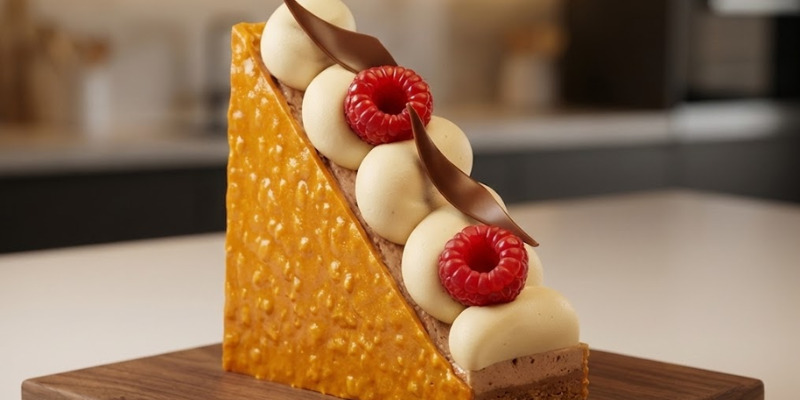
- Cut half into triangles and stand upright. Pipe whipped vanilla cream onto the cut side using a St. Honoré tip.
- Garnish with fresh raspberries and chocolate leaves.
Notes
 The Science of Ingredients: Inulin and Lamination
This recipe bridges traditional technique with modern food science.
1. Inulin HSI (The Texture Modifier)
The recipe uses Inulin HSI in both the cream and jelly.- The Science: Inulin is a dietary fiber derived from chicory root. In pastry, it acts as a bulking agent and fat mimetic. It binds water to create a creamy, gel-like texture that mimics the mouthfeel of fat, allowing us to reduce the heavy cream or sugar content without the result tasting watery or "diet." It provides body and stability to the whipped creams.
2. Pectin NH (Thermoreversibility)
The Raspberry Jelly uses Pectin NH.- The Science: Unlike the Yellow Pectin used in Pâte de Fruit (which sets irreversibly), Pectin NH is thermoreversible. This means you can set the jelly, cut it, or even remelt it if necessary, and it will set again. It requires calcium (found in fruit or milk) to set and creates a shiny, elastic texture perfect for fillings that need to hold their shape inside a layered slice.
3. Lamination (The Steam Engine)
The puff pastry relies on 5 single turns.- The Science: Puff pastry has no chemical leavener (baking powder). It rises solely due to mechanical leavening. The water in the dough turns to steam in the hot oven. This steam pushes against the waterproof layers of butter, lifting the dough. The gluten network traps the steam, cementing the lift. If the butter melts before the steam forms (oven too cold) or the layers stick (dough too warm), the pastry will be heavy and oily.
4. Amylase Deactivation (Boiling the Cream)
The pastry cream instructions emphasize boiling.- The Science: Egg yolks contain alpha-amylase, an enzyme that eats starch. If you don't bring the pastry cream to a boil, this enzyme survives. Over time (even in the fridge), it will digest the custard powder/starch, turning your thick cream back into a liquid soup. Boiling ensures the enzyme is denatured (destroyed).
Essential Professional Kitchen Tools
To achieve the "laser-cut" look, precise tools are non-negotiable.-
Silpain Mat (Perforated Baking Mat)
- Why you need it: Standard silicone mats trap moisture, leading to soggy bottoms. A Silpain mat is a mesh that allows air to circulate under the pastry. This ensures the bottom is just as crisp as the top. Baking the pastry under a Silpain mat (weighted down) keeps it perfectly flat and compact.
-
Serrated Roller (Docker)
- Why you need it: Docking the dough (poking holes) prevents large air bubbles from distorting the layers. A serrated roller does this uniformly in seconds, ensuring an even rise.
-
St. Honoré Piping Tip
- Why you need it: For the final garnish. The St. Honoré tip creates the signature "teardrop" or "zigzag" piping that adds volume and elegance to the side of the slice, contrasting the sharp geometric lines of the pastry.
-
Immersion Blender
- Why you need it: For the creams. To achieve a texture that is silky and shiny, you must emulsify the fat (chocolate/butter) with the liquid (milk/eggs). A whisk introduces air; a stick blender shears the particles together for a dense, glossy finish.
Expert Tips and Success Hacks
Achieve the sharp edges of a Parisian boutique with these secrets.1. The "Frozen Cut" Technique
Cutting a mille-feuille without squashing the cream is the hardest part.- The Hack: Assemble the strips of pastry and cream, then freeze the entire log for 20-30 minutes before cutting. The cream should be firm but not rock hard. Use a serrated knife and a gentle sawing motion. The firm cream will support the pressure, resulting in a clean cross-section.
2. Caramelizing for Crunch
How to keep the pastry crisp for longer?- The Hack: Dusting the baked pastry with fine sugar and blasting it at high heat (230°C) or using a blowtorch creates a microscopic layer of caramel on the surface. This caramel is hydrophobic (water-repelling), acting as a shield against the moisture of the cream, keeping the puff pastry crisp for hours longer than untreated dough.
3. Tempering the Yolk Mixture
Don't scramble the eggs.- The Hack: When adding hot milk to the yolk/sugar/starch mixture, pour only a splash first and whisk vigorously. This raises the temperature of the eggs gradually. If you dump all the boiling milk in at once, the thermal shock will cook the eggs into sweet scrambled eggs instantly.
4. Resting the Dough
Shrinkage is the enemy of rectangles.- The Hack: Gluten is elastic. If you roll out the dough and bake it immediately, it will snap back and shrink into a deformed oval. You must rest the dough in the fridge for at least 2 hours after the final roll-out before baking. This relaxes the gluten, ensuring the pastry keeps its shape.
5. Inulin Mixing
Inulin clumps easily.- The Hack: Always mix the Inulin powder with the granulated sugar before adding it to the liquid or yolks. The sugar crystals separate the fine inulin particles, allowing them to dissolve smoothly without forming gummy lumps.
Frequently Asked Questions (FAQ)
Q1: I can't find Inulin. What can I use? A: Inulin is unique, but if unavailable, you can replace it with an equal weight of Skim Milk Powder to add solids/creaminess, though it won't have the same fat-mimicking mouthfeel. Alternatively, just omit it and slightly increase the fat (butter/chocolate) or sugar, but the texture will be heavier. Q2: Can I make the puff pastry ahead? A: Yes. Puff pastry freezes exceptionally well. You can freeze the block of dough after the turns, or freeze the rolled-out sheets raw. Thaw in the fridge overnight before baking. Q3: Why bake between two mats? A: If you bake puff pastry freely, it puffs up wildly and unevenly (10cm high!). For a mille-feuille, we want compact, dense layers (approx 2cm high). Placing a Silpain mat and a heavy tray on top of the dough forces it to rise horizontally, creating a dense, super-crispy cracker-like texture. Q4: Can I use fresh fruit inside instead of jelly? A: Yes, but be careful. Fresh raspberries release water (bleed) very quickly, which will stain the cream and make the pastry soggy. The jelly acts as a stable flavor core. If using fresh fruit, place it only on the outer edges for decoration or consume immediately. Q5: How long does it keep? A: A mille-feuille has a very short shelf life.- Components: Pastry keeps for days (dry box). Creams keep for 2 days (fridge).
- Assembled: Must be eaten within 4-6 hours. After that, the moisture from the cream migrates into the pastry, and the "mille-feuille" (thousand leaves) becomes "mille-mush."
Tried this recipe?Let us know how it was!

I’m Chef Mimo, a passionate pastry chef with over 17 years of experience in the world of fine desserts. I specialize in French-style entremets, refined cakes, and creative chocolate work. Pastry is not just my profession—it’s my lifelong passion. Through PastryCrafted.com, I love sharing my recipes, techniques, and inspirations with anyone who dreams of mastering the art of pastry. Whether you’re a curious beginner or a seasoned pro, you’re welcome in my sweet world.