
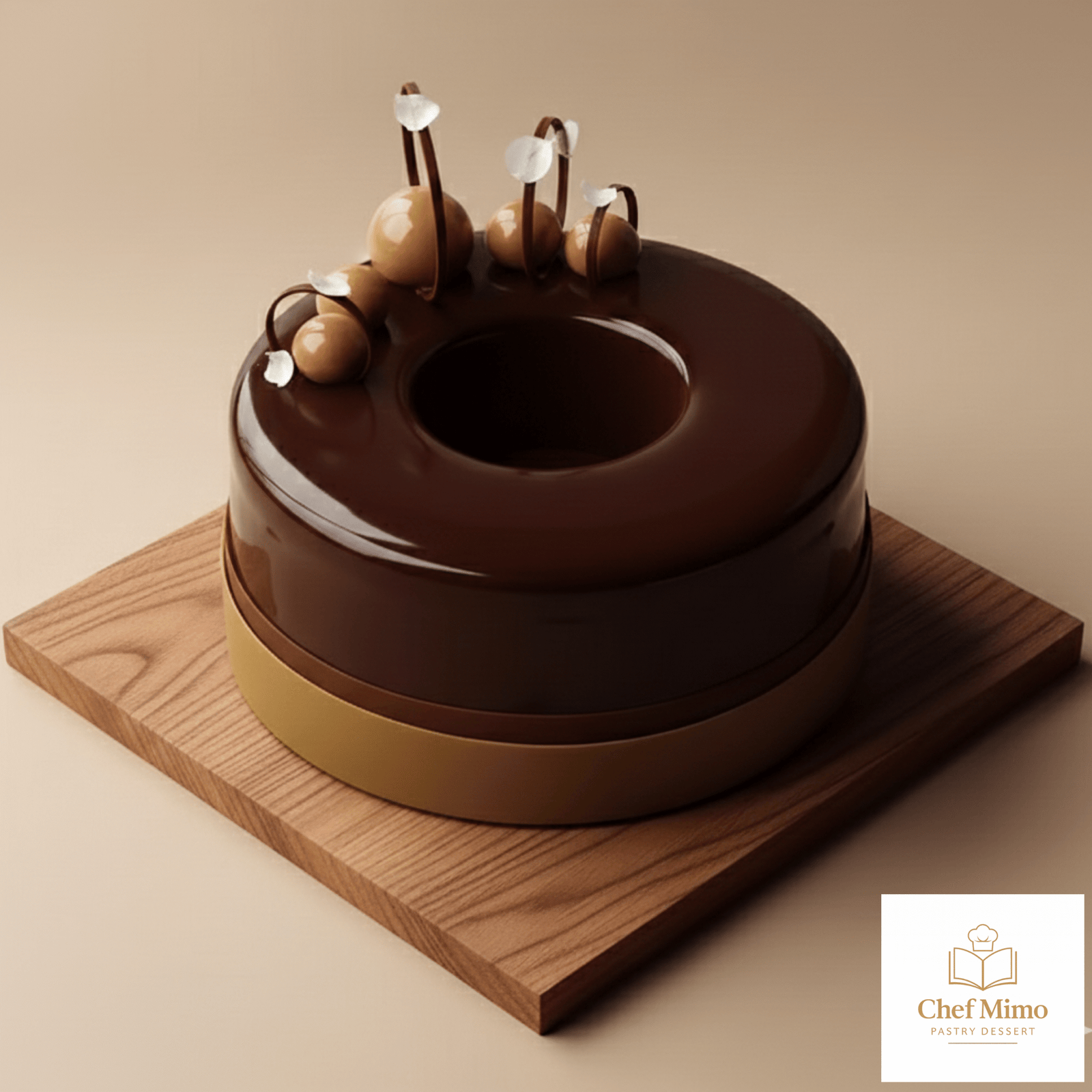
An iconic French classic redefined as an entremet, featuring coffee-soaked Joconde sponge, dark chocolate ganache, French coffee buttercream, and a delicate milk chocolate spiral insert.
Yields: 10 Servings
Target Mold Size: 18 cm diameter silicone mold (e.g., Silikomart TOR mold)
DAY ONE: Component Preparation & Internal Insert
1. Milk Chocolate Crèmeux Spiral (Insert Core)
| Ingredient | Weight (g) | Notes |
|---|---|---|
| Gelatin Sheet (240 Bloom) | 0.875 g | Approximately 1/2 sheet, bloomed |
| Milk Chocolate (30-35% cocoa solids) | 125 g | Finely chopped |
| Large Egg Yolks | 30 g | Approximately 2 yolks |
| Caster Sugar | 10 g | |
| Heavy Cream (35% fat) | 165 g | |
| Fine Sea Salt | Pinch |
Method
- Bloom Gelatin: Soak the gelatin in a bowl of ice-cold water for 5 to 10 minutes.
- Prepare Base: Whisk the egg yolks and sugar lightly in a bowl. Heat the heavy cream in a small saucepan almost to a boil. Remove from heat and pour the hot cream over the egg yolk/sugar mixture, whisking quickly.
- Cook Crèmeux: Return the mixture to the saucepan and stir continuously over low heat until the mixture reaches exactly 83°C (Nappe/Custard consistency). Precision is vital for stability. Remove from heat immediately.
- Emulsify: Sift the hot mixture into the finely chopped milk chocolate. Whisk in the bloomed gelatin until dissolved. Stir firmly in the center with a rubber spatula, then blend with an immersion blender until perfectly smooth.
- Fill Mold: Pour the crèmeux into a piping bag with a small hole sized to fit the spiral. Place the spiral mold (e.g., Silikomart Tourbillon Ø14) on a flat surface. Pour the crèmeux into the spiral. Tap the mold repeatedly on the workbench and use a toothpick to trace around the spiral grooves to remove all air bubbles.
- Freeze: Freeze the spiral for a minimum of 24 to 28 hours until completely solid.
2. Cocoa Biscuit with Coffee (Base Layer)
| Ingredient | Weight (g) | Notes |
|---|---|---|
| Digestive/Butter Biscuits | 125 g | |
| Unsalted Butter (melted) | 60 g | |
| Cocoa Powder (unsweetened) | 5 g | Equivalent of small 1 tbsp |
| Espresso Powder | 1.25 g | Equivalent of 1/2 tsp |
| Fine Salt | Pinch | |
| Milk Chocolate (for gluing) | Small amount | Melted |
Method
- Prepare Crumbs: Blend the biscuits in a food processor until fine crumbs are formed.
- Combine: Melt the butter and mix it with the biscuit crumbs, cocoa powder, espresso powder, and salt until evenly combined.
- Shape: Spread the biscuit base evenly into a 16 cm diameter pastry ring lined with a tall acetate collar and a parchment paper base. Level the surface using a flat glass or spatula.
- Chill: Place the cake insert ring in the refrigerator while preparing the other layers.
3. Joconde Almond Sponge Cake (Cake Layer)
| Ingredient | Weight (g) | Notes |
|---|---|---|
| Almond Flour | 170 g | |
| Caster Sugar (Base) | 105 g | |
| Whole Eggs | 200 g | |
| Egg Whites | 130 g | (For Meringue) |
| Caster Sugar (Meringue) | 55 g | |
| All-Purpose Flour | 35 g | Sifted |
| Unsalted Butter (melted) | 25 g |
Method
- Prepare Almond Base: Using a hand mixer, beat the almond flour, 105 g of caster sugar, and whole eggs until the mixture is fluffy and homogenous.
- Prepare Meringue: In a separate bowl, whisk the egg whites and 55 g of caster sugar to hard, stiff peaks.
- Fold: Gently fold the meringue into the almond base. Take care not to stir too much, which can deflate the air.
- Finish Batter: Sieve the all-purpose flour over the mixture and gently fold to combine. Finally, mix in the melted butter.
- Bake: Spread the batter onto a baking tray lined with parchment paper sprayed with non-stick spray. Bake in a conventional oven at 210°C for 7 to 9 minutes until the cake is springy and lightly golden.
- Cool and Cut: Let the cake cool completely. Use a 16 cm diameter pastry ring to cut two layers. If the cakes are taller than approximately 1.3 cm, trim the height to 1.3 cm. Wrap and reserve the cakes at room temperature.
4. Coffee Syrup
| Ingredient | Weight (g) | Notes |
|---|---|---|
| Caster Sugar | 50 g | |
| Espresso Powder | 7.5 g | Equivalent of 3 tsp |
| Water | 60 g | |
| Kahlua (or Cognac/Brandy) | 28 g | Optional |
Method
- Dissolve: Combine the water, sugar, and espresso powder in a small saucepan. Heat while whisking until all the sugar is dissolved.
- Finish: Remove from heat and stir in the Kahlua (if using). Allow to cool completely at room temperature.
5. Dark Chocolate Ganache
| Ingredient | Weight (g) | Notes |
|---|---|---|
| Heavy Cream (35% fat) | 309 g | Equivalent of 300 ml |
| Dark Chocolate (approx. 55% cocoa solids) | 250 g | Finely chopped |
| Unsalted Butter (room temperature) | 25 g |
Method
- Emulsify Base: Finely chop the dark chocolate and place it in a bowl. Heat the heavy cream until it is steaming and almost boiling. Remove from heat. Pour the hot cream over the chopped chocolate. Let set for 2 minutes, then stir firmly in the center of the bowl with a rubber spatula to combine.
- Blend: Add the room-temperature butter and blend the ganache with an immersion blender until smooth and homogenous.
- Thicken: Pour the ganache into a piping bag and let it rest at room temperature to thicken until it is pipeable (not fluid) for assembly. If necessary, briefly chill.
6. Chocolate Crunch with Coffee
| Ingredient | Weight (g) | Notes |
|---|---|---|
| Milk Chocolate (30-35% cocoa solids) | 45 g | Melted |
| Nutella (or similar chocolate-hazelnut spread) | 15 g | Equivalent of 1 tbsp |
| Feuilletine Flakes | 65 g | |
| Fine Salt | Pinch | |
| Espresso Powder | 5 g | Equivalent of 2 tsp |
Method
- Melt and Combine: Gently melt the 45 g of milk chocolate. Stir in the Nutella, feuilletine, espresso powder, and salt until evenly coated.
- Reserve: Place the crunch in an airtight box and keep it at room temperature until assembly.
7. French Coffee Buttercream (Crème au Beurre)
| Ingredient | Weight (g) | Notes |
|---|---|---|
| Espresso Powder | 8.75 g | Equivalent of 3 1/2 tsp |
| Boiling Water | 22.5 g | Equivalent of 1 1/2 tbsp (for dissolving coffee) |
| Water (Syrup) | 50 g | |
| Caster Sugar (Syrup) | 120 g | |
| Large Egg Yolks | 110 g | Approximately 6 yolks |
| Unsalted Butter (room temperature) | 230 g | Cubed |
Method
- Prepare Coffee: Dissolve the espresso powder in the 22.5 g of boiling water. Set aside to cool.
- Whip Egg Yolks: Beat the egg yolks with a hand mixer until they are thickened and pale yellow (this will take several minutes).
- Prepare Syrup: Combine the 120 g of sugar and 50 g of water in a small saucepan. Heat while stirring until the sugar is dissolved. Stop stirring and heat the mixture to a precise temperature of 116°C. Remove from heat.
- Make Pâte à Bombe: With the mixer running on high speed, slowly stream the 116°C hot syrup into the egg yolks. Continue whisking on high speed for 7 to 10 minutes until the bowl is no longer hot and the mixture is thick and dense.
- Incorporate Butter: Reduce the mixer speed to medium. Gradually add the room-temperature butter, one tablespoon at a time. Continue whisking until the buttercream is smooth and glossy.
- Add Coffee: Finally, incorporate the cooled, dissolved espresso mixture.
- Reserve: Transfer the buttercream to a piping bag and keep it at room temperature.
8. Assembly (The Entremet Insert)
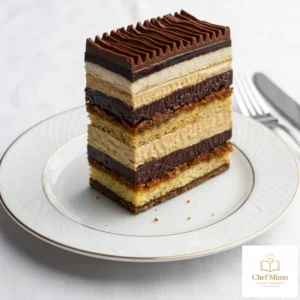
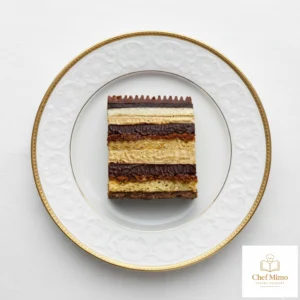
Layering Order (Bottom to Top): Biscuit Base $rightarrow$ Cake 1 $rightarrow$ Crunch 1 $rightarrow$ Ganache 1 $rightarrow$ Buttercream 1 $rightarrow$ Cake 2 $rightarrow$ Crunch 2 $rightarrow$ Ganache 2 $rightarrow$ Buttercream 2. Freeze 10-15 minutes between layers.
- Glue Base: Take the Cocoa Biscuit Base (in the 16 cm ring) out of the fridge. Brush a little melted milk chocolate onto the biscuit base for adhesion.
- Cake Layer 1: Place the first 1.3 cm Joconde sponge layer on top. Brush generously with the cooled Coffee Syrup. Freeze for 10 to 15 minutes until the syrup is absorbed and the surface is dry to the touch.
- Crunch Layer 1: Apply a thin, even layer of the Chocolate Crunch with Coffee, just enough to cover the surface. Freeze for 10 to 15 minutes.
- Ganache Layer 1: Apply a 1 cm thick layer of the thickened Dark Chocolate Ganache. Level the surface. Freeze for 10 to 15 minutes.
- Buttercream Layer 1: Apply a 1 cm thick layer of the French Coffee Buttercream. Level the surface. Freeze for 10 to 15 minutes.
- Cake Layer 2: Place the second 1.3 cm Joconde sponge on top. Brush generously with the Coffee Syrup. Freeze for 10 to 15 minutes.
- Crunch Layer 2: Apply a thin layer of the remaining Chocolate Crunch. Freeze for 10 to 15 minutes.
- Ganache Layer 2: Apply a 1 cm thick layer of the Dark Chocolate Ganache. Level the surface. Freeze for 10 to 15 minutes.
- Buttercream Layer 2 (Top of Insert): Apply a final 1 cm thick layer of the French Coffee Buttercream. Level the surface.
- Final Freeze: Freeze the entire 16 cm entremet insert overnight.
DAY TWO: Mousse & Entremet Construction
9. Almond Coffee Mousse and Mousse Domes
| Ingredient | Weight (g) | Notes |
|---|---|---|
| Gelatin Sheet (240 Bloom) | 6.1 g | Approximately 3 1/2 sheets, Extra Gold, bloomed |
| White Chocolate (30-35% cocoa butter) | 120 g | Finely chopped |
| Almond Nut Paste (Sub-recipe) | 120 g | See preparation notes below |
| Heavy Cream (for heating) | 180 g | Equivalent of 175 ml |
| Heavy Cream (for whipping) | 283 g | Equivalent of 275 ml, chilled |
| Espresso Powder | 5.6 g | Equivalent of 2 1/4 tsp |
Method (Almond Nut Paste – Sub-recipe)
- Blend 120 g of roasted blanched almonds with 4.5 g of icing sugar and 7 g of neutral oil (e.g., sunflower) in a mini chopper until a thick, smooth nut butter/paste is achieved.
Method (Mousse)
- Bloom and Melt: Soak the gelatin in cold water. Gently melt the white chocolate and reserve it in a mixing bowl.
- Combine Chocolate and Paste: Stir the 120 g almond nut paste into the melted white chocolate until homogenous.
- Infuse Cream: Heat the 180 g of heavy cream and 5.6 g of espresso powder almost to a boil, whisking to dissolve the powder. Remove from heat and whisk in the bloomed gelatin.
- Emulsify: Pour the hot cream mixture over the chocolate/almond mixture while stirring until combined. Allow the mass to cool to lukewarm (approx 28°C).
- Whip and Fold: Whip the remaining 283 g of heavy cream to soft peaks. Gently fold the whipped cream into the cooled chocolate/almond mixture.
- Fill Domes: Pour a small amount of mousse into two small silicone dome molds (e.g., Silikomart Truffles 20 and 5). Tap the molds on the counter to remove air bubbles.
- Fill Main Mold: Place the 18 cm silicone mold (e.g., Silikomart TOR) on a board, lined with an acetate collar. Pour the rest of the mousse into the mold.
- Insert Core: Retrieve the frozen 16 cm cake insert. Carefully press it down into the mousse with the final buttercream layer facing downwards.
- Freeze: Freeze the main cake and the mousse domes overnight.
DAY THREE: Glazing, Decoration & Final Finish
10. Milk Chocolate Mirror Glaze (Cake Base)
| Ingredient | Weight (g) | Notes |
|---|---|---|
| Gelatin Sheet (240 Bloom) | 10.5 g | 6 sheets, Extra Gold, bloomed |
| Milk Chocolate (33% cocoa solids) | 150 g | Finely chopped |
| Heavy Cream (35% fat) | 103 g | |
| Water | 50 g | |
| Caster Sugar | 150 g | |
| Glucose Syrup | 150 g | |
| Food Coloring Paste | – | Red, yellow, black, and white (to achieve milk chocolate/brown color) |
Method
- Bloom and Chop: Soak the gelatin in cold water. Chop the milk chocolate finely and place it in a large plastic pitcher.
- Prepare Syrup: In a saucepan, combine the sugar, water, heavy cream, and glucose syrup. Heat almost to a boil. Remove from heat and whisk in the bloomed gelatin.
- Emulsify Glaze: Pour the hot mixture over the chocolate. Allow to rest for 1 minute. Add the coloring pastes. Blend with an immersion blender (holding it at an angle to avoid air bubbles).
- Cool and Temper: Cover the surface directly with cling film and cool the glaze to its working temperature of 34°C to 35°C.
- Glaze Cake: Retrieve the frozen 18 cm entremet. Place it on a cooling rack. Pour the glaze over the cake. Clean the excess glaze from the bottom edge.
- Spiral Placement: After 10 minutes (while the glaze is still slightly soft), retrieve the completely frozen Milk Chocolate Crèmeux Spiral from the mold and carefully place it in the center on top of the cake. Leave the cake on the kitchen counter.
11. White Chocolate Mirror Glaze (Mousse Domes)
| Ingredient | Weight (g) | Notes |
|---|---|---|
| Gelatin Sheet (240 Bloom) | 5.25 g | 3 sheets, Extra Gold, bloomed |
| White Chocolate (28% cocoa solids) | 75 g | Finely chopped |
| Heavy Cream (35% fat) | 51.5 g | |
| Water | 25 g | |
| Caster Sugar | 75 g | |
| Glucose Syrup | 75 g | |
| Food Coloring Paste | – | Yellow, red, white, and black (to achieve a beige color) |
Method
- Prepare Glaze: Repeat the steps for the Milk Chocolate Glaze. Use the specified colors to achieve a beige tone.
- Glaze Domes: Retrieve the frozen mousse domes. Place them on a cooling rack. Pour the glaze over the domes. Clean the excess glaze from the bottom edge.
- Dome Placement: Immediately and carefully, place the 3 glazed domes inside the chocolate rings (to be made in Step 12) on top of the cake. For the smallest dome, carefully slice a bit off the bottom before placing it inside the smallest ring.
- Thaw: Let the cake thaw in the fridge for approximately 4 to 5 hours.
12. Chocolate Decoration (Ribbons and Rings)
| Material | Weight (g) | Notes |
|---|---|---|
| Milk Chocolate (33% cocoa solids) | 140 g | Tempered |
| White Chocolate (28% cocoa solids) | 130 g | Tempered and colored beige |
| Food Coloring Powder | – | Red, yellow, black, and white |
| Flower Leafs | – | For final garnish |
| Glucose Syrup | Small amount | For gluing decoration |
Dimensions (Ribbons from Tempered Chocolate)
- Milk Chocolate Ribbon 1: 4 cm x 59 cm
- Beige Chocolate Ribbon 2: 3 cm x 59 cm
- Beige Chocolate Ribbon 3 (Spiral Collar): 0.5 cm x 46 cm
Dimensions (Rings from Narrow Scraper)
- Chocolate Rings: 7 cm, 6 cm, and 5 cm diameter (adjusted by cutting)
Method
- Prepare Ribbons: Temper the specified amounts of chocolate. Spread onto acetate sheets cut to the ribbon dimensions. Allow to set until flexible, wrap around forms, and crystallize.
- Prepare Rings: Spread the tempered beige chocolate onto an acetate sheet and use a narrow chocolate scraper/pastry ring to cut out rings of 7 cm, 6 cm, and 5 cm diameters (or cut the ends shorter to size).
- Wrap Cake Base: Carefully place the Milk Chocolate Ribbon 1 around the 18 cm glazed cake. Secure the end with melted chocolate. Place the Beige Chocolate Ribbon 2 (3 cm) around the cake, securing the ends.
- Spiral Collar: Place the narrow Beige Chocolate Ribbon 3 (0.5 cm) around the Milk Chocolate Crèmeux Spiral.
- Position Rings: Place the three chocolate rings on the spiral beside the crèmeux, ensuring the furthest side of the ring aligns with the edge of the spiral. The ends of the ring should meet to support the weight of the mousse domes.
- Garnish: Secure flower leaves with a little melted chocolate or glucose syrup.

I’m Chef Mimo, a passionate pastry chef with over 17 years of experience in the world of fine desserts. I specialize in French-style entremets, refined cakes, and creative chocolate work. Pastry is not just my profession—it’s my lifelong passion. Through PastryCrafted.com, I love sharing my recipes, techniques, and inspirations with anyone who dreams of mastering the art of pastry. Whether you’re a curious beginner or a seasoned pro, you’re welcome in my sweet world.