
Passion Fruit Tartlets with Edible Viola Flowers – Exotic Mini Cakes with Coconut, Mango & Pistachio
A Garden Under Glass: Introduction to the Passion Fruit Viola Tart
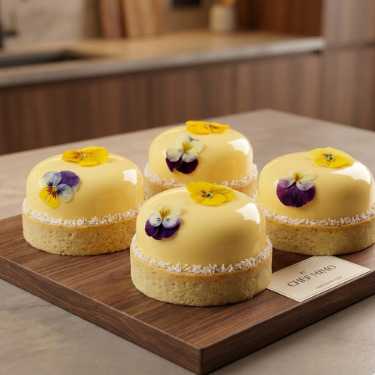
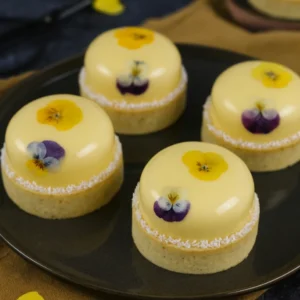
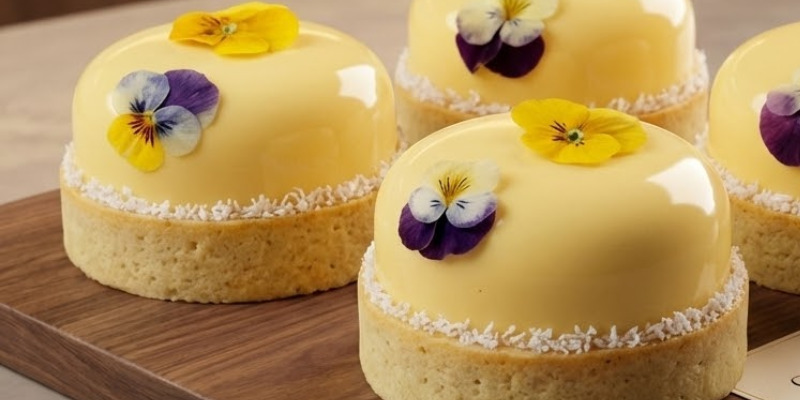
Modern pastry is as much about visual storytelling as it is about flavor. These Passion Fruit Tartlets tell a story of spring. The visual hook is immediate: a delicate, edible Viola flower suspended under a transparent glaze, encased in a silky mousse.But this dessert is not just a pretty face. It is a complex assembly of complementary flavors built on a professional 3-Day Schedule. The base is a nutty, green Pistachio Pâte Sucrée (inspired by Pierre Hermé's technique), filled with a moist Almond Sponge and a sharp Mango-Passion Crémeux. Sitting atop this foundation is the "dome": a Passion Fruit Mousse hiding a creamy Coconut Mascarpone center.Why make this? It is the ultimate "plated dessert" experience for the home baker. It teaches the "Reverse Assembly" technique—building the top of the cake upside down in a mold to achieve a perfect finish—and the delicate art of working with edible flowers in patisserie without wilting them.Ingredients
🥥 Coconut Cream – Day 1
- 100 g coconut purée
- 23 g sugar
- 1½ gelatin sheets
- 50 g mascarpone
🍰 Passion Fruit Mousse – Day 2
- 150 g cream
- 88 g passion fruit purée
- 2 egg yolks
- 25 g sugar
- 4½ gelatin sheets
- 175 g Valrhona Inspiration Passion fruit chocolate or similar
- 250 g whipping cream
- Edible viola flowers preferably fresh, unsprayed
🍥 Sponge Cake
- 30 g ground blanched almonds
- 20 g sugar I
- 1 whole egg
- 1 egg yolk
- 2 egg whites
- 22 g sugar II
- 35 g flour
🟩 Pistachio Pâte Sucrée (Pierre Hermé) – Day 3
- 75 g unsalted butter softened
- 50 g powdered sugar
- 10 g almond flour
- 5 g ground pistachios
- Seeds from ½ vanilla pod
- 125 g flour
- 30 g beaten egg
- Pinch of salt
🌰 Pistachio Cream (Optional)
- Sweet pistachio spread to brush tart base
🧡 Mango-Passion Fruit Crémeux
- 75 g passion fruit purée
- 75 g mango purée
- 1 egg + leftover beaten egg from pâte sucrée
- 1 egg yolk
- 40 g sugar
- 1½ gelatin sheets
- 90 g butter
✨ Mirror Glaze (Neutral)
- 6 gelatin sheets
- 143 g glucose syrup
- 112 g sugar
- 112 g water
Mastering Textures and Flavors📗 Download your PDF now!
Instructions
Day 1 – Coconut Cream
- Soak gelatin sheets in cold water for 10 minutes.
- Heat coconut purée and sugar in a saucepan. Remove from heat.
- Stir in the softened gelatin. Let cool slightly.
- Mix in mascarpone until smooth.
- Pour into silicone molds and freeze overnight.
Day 2 – Passion Fruit Mousse
- Soak gelatin in cold water. Finely chop the chocolate and place in a narrow bowl.
- In a saucepan, heat cream, passion fruit purée, egg yolks, and sugar over medium heat to about 85°C while stirring constantly.
- Pour the hot mixture over the chocolate. Let sit for 1 minute, then emulsify with a hand blender until smooth.
- Let cool to 35°C, then fold in whipped cream.
- Place two edible flowers in each mold, press gently.
- Pour in mousse gently to cover flowers.
- Insert frozen coconut cream into center and top with more mousse.
- Smooth the surface and freeze overnight.
Sponge Cake
- Preheat oven to 180°C (356°F).
- Whisk egg, yolk, sugar (I), and almonds until pale and fluffy.
- In a separate bowl, beat egg whites with sugar (II) to stiff peaks.
- Sift and fold in flour.
- Spread batter about 1 cm thick onto lined tray.
- Bake for 20 minutes. Let cool overnight.
Pistachio Past
- Cream butter and powdered sugar until light.
- Add almond flour, pistachios, vanilla seeds, salt, and beaten egg. Mix briefly.
- Add flour and mix just until combined.
- Wrap and chill for at least 2 hours.
- Roll out dough to 3–4 mm thick. Line tart rings placed on silicone mat.
- Freeze for 15 min to prevent shrinking.
- Preheat oven to 180°C.
- Bake tart shells for 20 min until golden. Let cool.
Mango-Passion Fruit Crémeux
- Soak gelatin in cold water.
- In saucepan, combine fruit purées, egg, yolk, and sugar.
- Cook over medium heat, stirring constantly, to 83°C.
- Remove from heat, stir in gelatin.
- Let cool to 40°C. Add cubed butter and blend with immersion blender until smooth.
Assembly
- Use a round cutter to cut sponge circles to fit tartlet bases.
- Spread a thin layer of pistachio cream in each baked tart shell.
- Place sponge disk on top.
- Pipe in the passion fruit-mango crémeux, filling the tart completely.
- Smooth the surface and chill until set.
Mirror Glaze
- Soak gelatin in cold water.
- Heat glucose, sugar, and water in saucepan to 100°C.
- Remove from heat and cool to 80°C.
- Add gelatin and stir until dissolved.
- Let cool to 32°C before using.
Final Assembly
- Set up 6 small glasses upside down on a tray.
- Unmold frozen mousse domes and place them on the glasses.
- Glaze with transparent mirror glaze.
- Wipe off drips with a small knife.
- Transfer domes onto filled tart shells.
- Decorate edges with shredded coconut and edible flowers.
Notes
 The Science of Ingredients: Couverture and Transparency
To achieve the vibrant color and see-through finish, specific ingredients are required.
1. Valrhona "Inspiration" (Fruit Couverture)
The mousse uses 175g of Valrhona Passion Fruit Inspiration.- The Science: This is not white chocolate flavored with fruit. It is a "Fruit Couverture" made from cocoa butter, sugar, and freeze-dried passion fruit powder. It contains no dairy solids. Because it behaves exactly like chocolate (it crystallizes), it provides structure to the mousse that fruit puree alone cannot. It delivers an intense, punchy acidity that cuts through the heavy cream, creating a mousse that tastes like pure fresh fruit.
2. Edible Viola Flowers (The Visual Element)
- The Science: Violas are chosen not just for color, but because they are robust. Their petals contain low water content compared to larger blooms, meaning they hold their shape well when frozen into the mousse. However, they are sensitive to pH. The acidity of the passion fruit mousse helps preserve the vibrant purple/yellow pigments (anthocyanins) of the petals, preventing them from turning brown.
3. Transparent Mirror Glaze (Neutral Nappage)
The glaze is a simple syrup of water, sugar, and glucose set with gelatin.- The Science: Unlike chocolate glazes which are opaque, this glaze relies on refractive index. By dissolving the sugar and glucose completely and removing all air bubbles, the glaze becomes optically clear. It acts as a lens, magnifying the flower and the bright yellow mousse underneath. Glucose syrup prevents the sugar from crystallizing, which would turn the glaze cloudy (white).
4. Mascarpone in Coconut Cream
The insert uses 50g of Mascarpone.- The Science: Coconut puree has a high water content and can be icy when frozen. Mascarpone is a triple-cream cheese (approx. 40%+ fat). By mixing it into the coconut base, we increase the dry matter and fat content. This creates a "cryoprotectant" effect, ensuring the center remains creamy and soft even when served semi-frozen, rather than turning into a hard ice cube.
Essential Professional Kitchen Tools
To execute the "flower-in-glass" look, you need precise tools.-
Silicone Dome Molds (Pomponettes or Truffles)
- Why you need it: You need two sizes. Smaller cavities for the Coconut Insert, and larger domes (like Silikomart "Stone" or "Globe") for the main Passion Fruit Mousse. The flexibility of silicone allows you to pop out the frozen mousse without damaging the delicate flower embedded in the surface.
-
Perforated Tart Rings (8cm)
- Why you need it: For the Pistachio Pâte Sucrée. Standard fluted tins inhibit airflow. Perforated rings allow moisture to escape from the sides of the tart shell, ensuring a perfectly crisp, vertical edge that doesn't shrink.
-
Digital Thermometer
-
Why you need it: Precision is vital.
- Crémeux: Must reach 83°C to thicken the eggs without scrambling.
- Glaze: Must be poured at 32°C. If 35°C, it melts the mousse. If 28°C, it is too thick and won't be transparent.
-
Why you need it: Precision is vital.
-
Immersion Blender
- Why you need it: For the Glaze and Crémeux. A whisk introduces air bubbles. In a transparent glaze, bubbles look like flaws in a diamond. An immersion blender removes air, creating a glass-like finish.
Expert Tips and Success Hacks
Achieve the boutique look with these professional secrets.1. The "Upside Down" Flower Placement
The flower must be placed correctly in the mold (Day 2).- The Hack: Place the Viola flower face down into the bottom of the silicone mold. Ensure the petals are open and flat. Gently pipe a teaspoon of mousse over the flower and use a small brush or spoon to push the mousse into the crevices of the petals to remove air pockets. Then fill the rest of the mold. This ensures no air bubbles ruin the visual of the flower.
2. Pistachio "Waterproofing"
The tart shell holds a wet sponge and moist cream.- The Hack: The recipe mentions brushing with Pistachio Cream. This isn't just for flavor; it's a moisture barrier. The fat in the pistachio paste seals the porous tart shell. Without it, the moisture from the mango crémeux would seep into the crust, making it soggy within 2 hours.
3. The Glaze Temperature Sweet Spot
Transparent glaze is unforgiving.-
The Hack: You must pour at 32°C.
- Too Hot: It melts the outer layer of the mousse, creating milky streaks that cloud the view of the flower.
- Too Cold: It goes on thick and rubbery, looking like plastic wrap.
- Technique: Pour generously in one motion. Do not go back and touch it with a spatula.
4. Sponge Moisture
The almond sponge can be dry.- The Hack: Although not explicitly in the ingredients, professional chefs often brush the baked almond sponge with a little Passion Fruit Syrup (juice + sugar) before placing it in the tart. This creates a "Baba" effect, keeping the dessert moist and amplifying the tropical flavor.
5. Managing Tart Shrinkage
Pistachio dough is delicate.- The Hack: After lining your rings with the Pistachio Pâte Sucrée, freeze them for 20 minutes before baking. This relaxes the gluten and hardens the butter. A frozen shell hits the hot oven and sets its shape before it has time to slump or shrink down the sides.
Frequently Asked Questions (FAQ)
Q1: I can't find Valrhona Passion Inspiration. Substitute? A: This is hard to replace exactly. The best alternative is White Chocolate mixed with Freeze-Dried Passion Fruit Powder (intense flavor, low moisture). Do not add fresh puree to white chocolate for the mousse base, or it will seize. Alternatively, make a standard fruit mousse using puree and gelatin, but it won't be as creamy. Q2: Can I use different flowers? A: Yes, provided they are edible and pesticide-free. Pansies work well (they are larger violas). Nasturtiums add a peppery bite. Borage (blue star flowers) looks stunning. Avoid thick flowers like roses, which don't sit flat in the mold. Q3: Why is my glaze cloudy? A: Cloudiness comes from two sources:- Micro-bubbles: You whisked the glaze. Strain it and let it rest overnight.
- Sugar crystallization: You didn't use enough glucose syrup or didn't dissolve the sugar fully. Ensure the syrup boils clear before adding gelatin.
Tried this recipe?Let us know how it was!

I’m Chef Mimo, a passionate pastry chef with over 17 years of experience in the world of fine desserts. I specialize in French-style entremets, refined cakes, and creative chocolate work. Pastry is not just my profession—it’s my lifelong passion. Through PastryCrafted.com, I love sharing my recipes, techniques, and inspirations with anyone who dreams of mastering the art of pastry. Whether you’re a curious beginner or a seasoned pro, you’re welcome in my sweet world.