
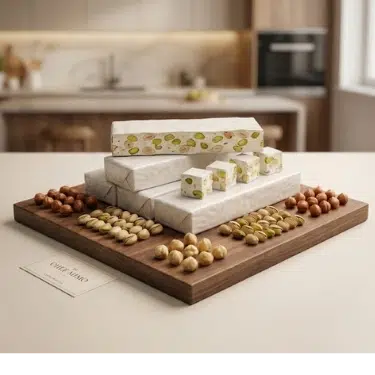
Soft Nougat (Nougat Tendre)
The Art of the Montélimar Style: Introduction to Soft Nougat
In the realm of French confectionery, Nougat de Montélimar stands as a pillar of technical mastery. Unlike the brittle, tooth-shattering nougats of some traditions, a true "Nougat Tendre" (Soft Nougat) is a cloud-like suspension of honey, sugar, and egg whites, studded with the crunch of roasted nuts. It is a texture that is simultaneously chewy, airy, and melting.This specific recipe is a professional-grade formulation that relies on a double-cooking method. It involves managing two separate syrups—honey cooked to 121°C and a sugar-glucose syrup cooked to a precise 152°C–155°C—poured sequentially over aerated egg whites. Enriched with cocoa butter rather than dairy butter, this nougat possesses a cleaner shelf life and a luxurious mouthfeel that doesn't feel greasy.Why master this? Because it is the ultimate test of timing. It forces the baker to become a conductor, managing the rhythm of the mixer, the heat of the honey, and the boil of the sugar syrup simultaneously. The reward is a confection that far surpasses anything store-bought: a pristine white block of sweet aeration, generously filled with warm, toasted almonds, hazelnuts, and pistachios, sandwiched between delicate wafer paper (azyme).Ingredients
🍬 For the Base
- 60 g Egg Whites
- 85 g Glucose Syrup as used for mirror glazes
- 125 g Mineral Water
- 380 g Granulated Sugar for the syrup
- 20 g Granulated Sugar for meringue
- 290 g Honey Acacia is recommended for its neutral flavor
🍫 For Enrichment
- 125 g Cocoa Butter melted, kept warm
🥜 For the Garnish
- 360 g Dried Fruits/Nuts combined (Keep warm)
- 200 g Almonds
- 100 g Hazelnuts
- 60 g Shelled Pistachios
- Note: The total quantity of nuts should be 360g; adjust composition as desired.
🍽️ Other
- 2 Azyme Sheets wafer paper, one for the bottom, one for the top
Mastering Textures and Flavors📗 Download your PDF now!
Instructions
Preparation and Mise en Place
- Mold Prep: Adjust your adjustable frame to 19cm x 28cm. Lightly grease the inside of the frame.
- Line a flat plate or baking sheet with one azyme sheet (smooth side up). Place the frame over the sheet.
- Cut the second azyme sheet to fit the frame and set it aside for later.
- Ingredient Prep: Place the egg whites in the mixer bowl. Put the honey in one medium saucepan. Put the water, 380g sugar, and glucose syrup in a second saucepan. Place the 20g sugar in a small cup. Place the 125g cocoa butter in a large bowl.
- Nuts: Preheat your oven to 150°C (300°F). Spread the nuts evenly on a baking sheet. Bake for 15 minutes. Turn off the oven, but leave the nuts inside to keep them warm until use. They must be warm, not cold, when incorporated.
Cooking and Mixing
- Start Syrups: Begin heating the sugar/glucose/water syrup over medium heat. This syrup heats the slowest.
- Start melting the cocoa butter (e.g., in a microwave) and set it aside. It must be warm when incorporated.
- Start whipping the egg whites slowly in the stand mixer.
- Begin heating the honey in its saucepan. (Honey heats very quickly.)
Meringue and Syrups
- Honey Stage: As the egg whites reach soft peaks, increase the mixer speed. Incorporate the 20g sugar (in three additions) to firm them up (like a meringue).
- Increase the heat on the syrups. When the honey reaches 121°C (250°F), reduce the mixer speed to low and pour the honey in a slow, steady stream onto the meringue, pouring it against the side of the bowl. Once all the honey is incorporated, increase the speed again.
- Sugar Syrup Stage: Monitor the sugar/glucose syrup. The target temperature range is 152°C to 155°C (306°F to 311°F).
- Crucial Temperature Control: If the temperature is below 152°C, the nougat may be too soft and runny. If above 155°C, it will be too hard.
- When the syrup reaches 152-153°C, stop the heat immediately, as the boiling will continue briefly.
- Reduce the mixer speed to low and pour the sugar syrup onto the meringue, taking extreme care to avoid splatters.
- Once the syrup is incorporated, increase the speed again and mix for no more than 2 minutes. The meringue should be smooth and ultra-shiny.
Incorporation and Setting
- Incorporate Fats: Stop the mixer. Quickly switch the whisk attachment for the paddle attachment.
- Add the warm, melted cocoa butter and mix on low speed for about 1 minute until fully incorporated.
- Add the warm nuts from the oven. Mix until the nuts are evenly distributed (this happens quickly).
- Check Texture (Optional Tip): Take a small piece of the nougat paste and run it under cold water. If the texture is too soft, heat the bowl with a hairdryer for 2 minutes to dry out the mixture slightly (though this should be unnecessary if temperatures were respected).
- Mold: Immediately pour the nougat paste into the prepared frame.
- Use an offset spatula to spread and level the nougat, ensuring a smooth, even surface.
- Place the second azyme sheet on top and press gently to adhere.
- Leave the nougat to set at room temperature overnight without touching it.
Cutting and Storage
- The next day, remove the frame.
- Use a long, sharp knife dipped in very hot water and wiped dry to cut the nougat into desired strips (2.5cm to 3cm) or cubes. Repeat the process of heating and wiping the blade for each cut.
- Storage: The nougat can be stored for up to three months. If the climate is warm and the nougat feels sticky, wrap the pieces in plastic film, place them in an airtight container, and store in the refrigerator. Take them out about 30 minutes before serving to prevent them from becoming too hard.
Notes
The Science of Ingredients: The Chemistry of Sugar Cookery
Nougat is essentially an aerated candy. Understanding the physics of sugar is non-negotiable here.1. Double Syrup System (Honey vs. Glucose)
This recipe cooks honey and sugar separately.- The Science: Honey contains fructose and impurities (flavor) that burn easily at high temperatures. We cook it to 121°C (firm ball stage) to sanitize it and drive off some water without destroying its delicate floral notes. The sugar/glucose syrup is cooked much higher, to 152°C–155°C (hard crack stage). By combining them, we get the best of both worlds: the flavor of honey and the structural stability of high-cooked sugar. If you cooked the honey to 155°C, it would taste bitter and burnt.
2. Cocoa Butter (The Stabilizer)
Unlike traditional recipes that might use no fat or dairy butter, this uses cocoa butter.- The Science: Cocoa butter is a stable fat that is solid at room temperature but melts at body temperature. In nougat, it provides "shortness" to the chew—meaning the nougat breaks cleanly rather than stretching endlessly like taffy. It also acts as a moisture barrier, preventing the nougat from becoming sticky in humid environments.
3. Glucose Syrup (Crystallization Inhibitor)
A significant amount of glucose (85g) is used in the sugar syrup.- The Science: When you boil sucrose (granulated sugar) to 155°C, it desperately wants to recrystallize into a grainy, sandy mess. Glucose syrup consists of long chains of molecules that physically get in the way of sucrose molecules, preventing them from bonding. This ensures the nougat remains smooth and amorphous (glass-like structure) rather than gritty.
4. Warm Nuts (Thermal Shock Prevention)
The recipe insists on adding nuts that are warm from the oven.- The Science: This is a matter of thermodynamics. The nougat paste is hot (around 120°C+ during mixing). If you dump in room-temperature nuts, you shock the sugar matrix, causing it to seize instantly. The mixture will become rock hard in the bowl before you can even pour it into the frame. Warm nuts maintain the plasticity of the paste, giving you time to mold it.
Essential Professional Kitchen Tools
You cannot "wing it" with nougat. Specific tools are required for safety and success.-
Stand Mixer with Paddle & Whisk
- Why you need it: You need the Whisk for the initial aeration of egg whites and pouring the syrups. However, once the mixture thickens and you add the heavy nuts, you must switch to the Paddle attachment. A whisk acts like a cage; the nuts will get stuck inside, and the resistance of the thick paste will snap the thin wires of the whisk.
-
Digital Candy Thermometer (Fast Response)
- Why you need it: You are monitoring two pots. The difference between soft nougat (152°C) and hard brittle (158°C) is seconds. An old-fashioned analog thermometer is too slow.
-
Adjustable Stainless Steel Frame
- Why you need it: Nougat doesn't hold its shape until set. You need a rigid metal frame placed on a silicone mat or parchment. The frame creates the straight edges necessary for cutting professional bars.
-
Azyme Sheets (Wafer Paper)
- Why you need it: Fresh nougat is incredibly sticky. "Paper Azyme" (made from potato starch and oil) is edible and flavorless. It acts as a "skin" for the top and bottom, allowing you to handle, stack, and package the nougat without it sticking to your fingers or wrappers.
Expert Tips and Success Hacks
The difference between a sticky mess and a perfect bar lies in these details.1. The "Hairdryer" Rescue
Sometimes, even with the right temperatures, the nougat looks too soft or runny in the bowl.- The Hack: Before pouring it into the mold, aim a hairdryer (on high heat) at the outside of the mixer bowl while the paddle is running. This external heat helps evaporate residual moisture from the whites or honey, drying out the paste ("dessécher") to stiffen the texture. Professional nougatiers use gas torches, but a hairdryer works for small batches.
2. The Clean Pour
Syrup splatter is dangerous and wasteful.- The Hack: When pouring the 152°C syrup, aim for the space between the whisk and the side of the bowl. Do not hit the whisk (it spins hot sugar everywhere) and do not just trickle it down the side (it cools and sticks to the bowl, ruining your ratio). Pour in a confident, steady stream.
3. Hot Knife Cutting
Cutting nougat is a workout.- The Hack: Do not use a serrated knife; use a long chef's knife. Prepare a tall pitcher of boiling water. Dip the knife, wipe it dry, and make one clean cut. The heat melts the cocoa butter and sugar path, allowing the blade to glide. If it sticks, re-dip. Do not saw back and forth.
4. Mise en Place Timing
The hardest part is syncing the two syrups.-
The Hack:
- Start the Sugar/Water syrup first (it takes longer to reach 152°C).
- When the sugar syrup hits 110°C, turn on the heat for the Honey (it cooks fast).
- Start whipping whites when Honey hits 100°C. By the time the Honey hits 121°C, your whites will be at soft peaks, and your Sugar syrup will be lagging behind perfectly, ready to hit 152°C just after you finish pouring the honey.
5. Compressing the Mold
Air pockets are the enemy.- The Hack: After pouring the nougat into the frame and adding the top wafer paper, place a heavy cutting board or book on top of the frame for the first hour of setting. This compression ensures the nougat is perfectly flat and dense, and that the wafer paper adheres completely.
Frequently Asked Questions (FAQ)
Q1: My nougat is too soft and won't hold its shape. Why? A: The sugar syrup temperature was too low (under 152°C), or there was too much humidity in the room. Sugar is hygroscopic. If it's a rainy day, nougat absorbs moisture from the air. You can try the "hairdryer trick" next time, or cook the syrup to 155°C in humid weather. Q2: My nougat is rock hard. Can I fix it? A: Unfortunately, no. If the syrup went above 156°C-158°C, you have made hard candy/brittle. It will still taste delicious, but it will be a crunchy nougat (Nougat Dur) rather than a soft one. Enjoy it as a hard candy! Q3: Can I swap the nuts? A: Absolutely. The recipe calls for 360g total. You can use macadamias, pecans, or dried cranberries/cherries. Just keep the ratio of "inclusions" to "paste" somewhat consistent so the nougat holds together. Ensure all nuts are roasted; raw nuts taste bland in nougat. Q4: What if I can't find Azyme/Wafer sheets? A: You can use Rice Paper (edible spring roll wrappers), though they are a bit chewier. Alternatively, dust your mold and the top of the nougat heavily with a mix of cornstarch and powdered sugar to prevent sticking, then brush off the excess before cutting. Q5: How do I store it in summer? A: In hot weather (>25°C), the cocoa butter may soften, making the nougat greasy or sticky. Store the cut pieces in an airtight container in the fridge, separated by parchment paper. Let them come to room temperature for 20 minutes before eating to restore the soft texture.
Tried this recipe?Let us know how it was!

I’m Chef Mimo, a passionate pastry chef with over 17 years of experience in the world of fine desserts. I specialize in French-style entremets, refined cakes, and creative chocolate work. Pastry is not just my profession—it’s my lifelong passion. Through PastryCrafted.com, I love sharing my recipes, techniques, and inspirations with anyone who dreams of mastering the art of pastry. Whether you’re a curious beginner or a seasoned pro, you’re welcome in my sweet world.