
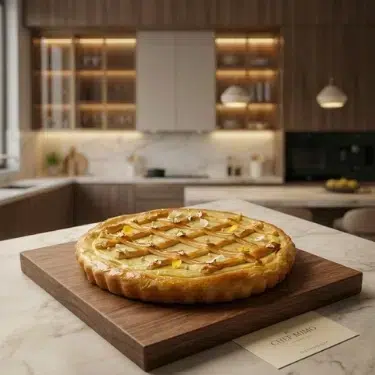
Tarte au Libouli (Thick-Crust Custard Tart)
The "Gros Bords" of the Boulonnais: Introduction to Tarte au Libouli
In the pantheon of French tarts, the Tarte au Libouli stands apart. While Parisian tarts rely on crisp shortcrust and refined mousses, this rustic specialty from the Pas-de-Calais region (specifically the Boulonnais) is built on comfort and sustenance. The name "Libouli" comes from the local dialect for "boiled milk" (lait bouilli), referring to the rich custard filling. It is also famously known as Tarte à gros bords ("Thick-Crust Tart") because of its signature raised edges, designed historically to hold a generous amount of filling without spilling in wood-fired ovens.This dessert is a hybrid: part brioche, part flan. The base is not a cookie-like crust but a soft, leavened Brioche Dough. It is filled with a dense, vanilla-scented custard made with whole eggs, which is then baked again inside the shell. The result is a study in textures: the chewy, buttery crumb of the brioche contrasting with the smooth, trembling set of the baked cream.Why master this recipe? It teaches the fundamentals of Enriched Doughs (managing yeast and fat) and the technique of Double Baking a custard without curdling it. It is the ultimate comfort food—simple, hearty, and steeped in history.Ingredients
🍞 For the Brioche Dough
- 250 g All-Purpose Flour or high-quality Gruau flour
- 100 ml Milk slightly warmed
- 60 g Melted Butter cooled
- 20 g Granulated Sugar
- 1 Whole Egg
- 4 g Dry Baker's Yeast
- OR 10g Fresh Baker's Yeast
- 1 pinch Salt
🥛 For the Pastry Cream (Crème Pâtissière)
- 600 ml Milk
- 3 Whole Eggs
- 50 g Cornstarch Maïzena
- 90 g Granulated Sugar
- 1 Vanilla Bean
✨ For the Glaze (Optional)
- Neutral Glaze or Apricot Glaze
Mastering Textures and Flavors📗 Download your PDF now!
Instructions
Prepare the Brioche Dough
- In the bowl of a stand mixer (or a large bowl for kneading by hand), add the ingredients in this order: salt, sugar, flour, yeast (diluted in slightly warmed milk), cooled melted butter, and the egg. Caution: Ensure the yeast does not directly touch the salt.
- Knead at low speed for 2 minutes, then increase to medium speed for 10 to 15 minutes. The dough should become elastic and detach easily from the sides of the bowl.
- Form the dough into a ball and let it rest at room temperature for 1 to 1.5 hours until it doubles in volume.
Prepare the Pastry Cream
- While the dough is rising, prepare the pastry cream.
- Pour 300ml of the milk, half of the sugar (45g), and the scraped vanilla seeds (and the pod) into a saucepan. Bring to a boil and immediately remove from heat.
- In a separate bowl, whisk the remaining sugar (45g) with the 3 whole eggs. Sift the cornstarch over the mixture and whisk until combined.
- Slowly pour the hot milk mixture over the egg mixture while whisking constantly.
- Return the entire preparation to the saucepan. Cook over low to medium heat, stirring continuously. Do not boil rapidly or the eggs will coagulate.
- Once the cream thickens, continue cooking for 1 to 2 minutes to ensure the starch flavor is cooked out.
- Transfer the cream to a clean bowl and cover the surface with plastic wrap (filmer au contact) to prevent a crust from forming. Let cool completely.
Assembly and Baking
- Prep: Preheat your oven to 180°C (350°F).
- Degas: Punch down the risen dough to release the air (degazez). Reform it into a ball by folding it over itself several times.
- Crosshatch (Optional): Reserve a small portion of the dough now to create the decorative lattice strips later.
- Shape: Lightly flour your work surface and roll out the remaining dough.
- Place: Grease your 24cm tart pan or line the bottom with parchment paper. Place the dough into the pan and form the thick edges (gros bords) by folding the dough back on itself around the entire circumference.
- Fill: Once the pastry cream is completely cool, whisk it briefly to smooth it out (détendre). Pour the cream evenly into the tart shell, leveling the surface with an offset spatula.
- Decorate: Roll out the reserved dough and cut thin strips. Lay them over the cream to create a crosshatch/lattice pattern.
- Glaze: Brush the dough strips with a mixture of egg yolk and milk or cream for a golden finish.
- Bake: Bake for 35 to 40 minutes, depending on your oven, until the crust is golden brown and the cream is set.
- Finish: You can brush the tart with a neutral glaze (nappage neutre) immediately after baking to make it shine.
- Enjoy!
Notes
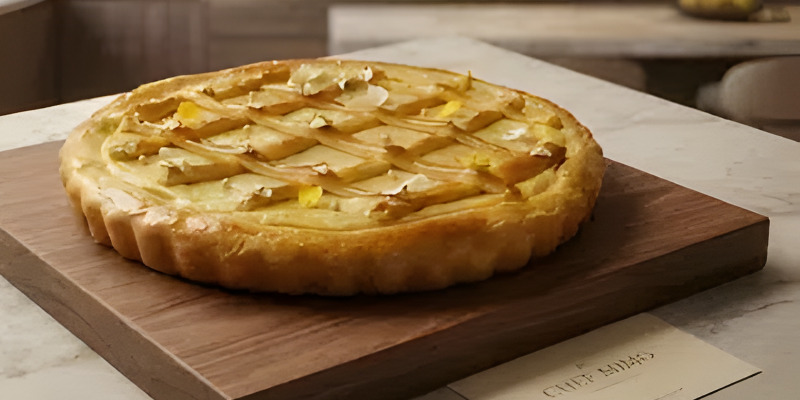 The Science of Ingredients: Yeast and Custard Chemistry
This recipe combines biology (yeast) and chemistry (starch/protein).
1. Baker's Yeast (Biological Leavening)
Unlike the baking powder used in cakes, this tart uses live yeast.- The Science: Saccharomyces cerevisiae feeds on the sugars in the flour and releases carbon dioxide (CO2) and alcohol. This fermentation creates the airy, honeycomb structure of the brioche rim. Because the dough is "enriched" (high in fat/eggs), the fat coats the flour proteins, making it harder for the gluten network to hold this gas. This is why the kneading time (10–15 minutes) is crucial—you must mechanically force the gluten strands to align strong enough to trap the gas despite the fat interference.
2. Whole Eggs in Pastry Cream
Classic Crème Pâtissière uses only yolks. This rustic version uses whole eggs.- The Science: Egg whites contain albumin, a protein that sets firm and rubbery when heated. In a fine éclair, this is undesirable. But in a Tarte au Libouli, the cream is baked in the oven. The albumin provides extra structure, ensuring the custard sets firm enough to be sliced cleanly like a pie, rather than oozing out like a sauce. It gives the filling a denser, more "flan-like" mouthfeel characteristic of farmhouse desserts.
3. Cornstarch (The Binding Agent)
The recipe relies on 50g of Cornstarch (Maïzena).- The Science: Because the cream is baked, you might think the eggs alone would set it. However, the starch prevents "syneresis" (weeping). Without starch, the egg proteins would tighten up in the oven heat, squeezing out the water (milk). The gelatinized starch absorbs this water, keeping the custard smooth and preventing it from turning into scrambled sweet eggs inside the tart.
4. Milk (The "Libouli")
The custard uses a high volume of milk (600ml).- The Science: This high liquid ratio creates a custard that is lighter than a cheesecake but richer than a pudding. The proteins in the milk skin over during baking, creating the signature golden-brown "blistered" top often seen on rustic tarts (unless covered by lattice).
Essential Professional Kitchen Tools
To handle the sticky dough and hot cream, you need specific tools.-
Stand Mixer with Dough Hook
- Why you need it: Brioche dough is sticky. To develop the gluten sufficiently without adding too much extra flour (which makes the bread dry), you need the mechanical power of a mixer. Hand-kneading works, but it takes double the time and requires skill to avoid drying out the dough.
-
24cm Tart Ring or Springform Pan
- Why you need it: Unlike a shallow tart tin, a Tarte au Libouli needs height. The "Gros Bords" need a vertical wall to lean against as they rise. A high-sided ring or springform pan ensures the custard stays contained.
-
Offset Spatula
- Why you need it: After pouring the custard into the raised dough shell, you must level it perfectly. An offset spatula allows you to smooth the hot cream without dipping your knuckles into the filling or damaging the delicate brioche rim.
-
Whisk (Fouet)
- Why you need it: Essential for the custard. You must whisk the egg/starch mixture vigorously while pouring in the hot milk to prevent the eggs from cooking instantly ("tempering").
Expert Tips and Success Hacks
Achieve the authentic "Northern" texture with these secrets.1. The "Windowpane" Test
How do you know the dough is kneaded enough?- The Hack: Stop the mixer. Tear off a small piece of dough and gently stretch it between your fingers. It should stretch into a thin, translucent membrane (like a windowpane) without tearing. If it snaps immediately, the gluten isn't developed—keep kneading. If you bake it now, the brioche will be heavy and dense.
2. The "Gros Bords" Fold
The thick edge is the signature of this tart.- The Hack: Roll the dough larger than your pan (about 3-4 cm overhang). Place it in the pan. Instead of cutting off the excess, fold the overhang back into the pan, creating a double-thick wall of dough around the perimeter. Press this rim gently. This creates the structural dam that holds the heavy cream and rises into a beautiful, golden pillow.
3. Cooling the Cream (Safety & Texture)
Do not pour boiling cream onto raw yeast dough.- The Hack: If you pour 100°C cream onto the brioche base, you will kill the yeast in the bottom layer instantly, resulting in a gummy, undercooked layer (the "soggy bottom"). Cool the pastry cream to at least 40°C (warm) before filling. This protects the yeast and ensures the dough bakes properly.
4. Lattice Precision
The lattice strips are soft and stretchy.- The Hack: Chill the reserved dough ball for 20 minutes before rolling out the strips. Cold dough cuts cleaner and doesn't stretch out of shape when you lift it. Use a pizza cutter for razor-sharp lines.
5. Preventing "Skin" on the Custard
- The Hack: While the recipe suggests plastic wrap, another traditional trick is to rub a cold stick of butter over the surface of the hot pastry cream immediately after cooking. The melting butter creates a fat barrier that prevents the air from drying out the surface proteins, stopping a skin from forming.
Frequently Asked Questions (FAQ)
Q1: Can I make this with puff pastry instead? A: Technically, yes, but then it becomes a Flan Pâtissier (Parisian Flan), not a Tarte au Libouli. The defining characteristic of the Libouli is the yeast-leavened brioche base. The texture interplay between bread and custard is what makes it unique. Q2: My brioche rim collapsed during baking. Why? A: This usually happens if the dough was "over-proofed" (left to rise too long). If the yeast exhausts all its food before the oven, the structure becomes weak and collapses. Only let the dough rise until double in volume—no more. Also, avoid opening the oven door early. Q3: Can I add fruit? A: Yes! A very traditional variation involves placing Prunes (often soaked in tea or rum) or Raisins at the bottom of the tart shell before pouring the custard. Thin slices of apple are also common in the Boulonnais region. Q4: How do I store it? A: Because it contains custard and brioche, it must be refrigerated. However, brioche goes stale quickly in the fridge.- Short term: Store in the fridge for up to 2 days.
- Serving: Remove from the fridge 30 minutes before eating to allow the brioche to soften and the flavor of the cream to open up.
Tried this recipe?Let us know how it was!

I’m Chef Mimo, a passionate pastry chef with over 17 years of experience in the world of fine desserts. I specialize in French-style entremets, refined cakes, and creative chocolate work. Pastry is not just my profession—it’s my lifelong passion. Through PastryCrafted.com, I love sharing my recipes, techniques, and inspirations with anyone who dreams of mastering the art of pastry. Whether you’re a curious beginner or a seasoned pro, you’re welcome in my sweet world.