My Basic recipes
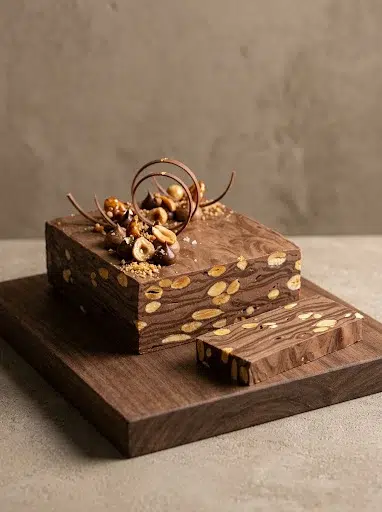
Chocolate Nougat & Chewy Caramel Layers
PASTRYCRAFTED · CONFECTIONERY
- Style
- layered confection, cut into pieces and individually wrapped.
Honey nougat enriched with dark chocolate and cocoa butter, layered with thin sheets of salted caramel. Roasted almonds add crunch throughout, contrasting with the chewy confection.
Caramel: 118°C · Honey: 120°C · Nougat sugar syrup: 155°C
Chocolate incorporation: 50–60°C · Caramel sheets: approximately 2 mm · Setting: overnight at room temperature

Ingredients
Ingredients by component
Chocolate nougat · Honey
- Honey240 g
Chocolate nougat · Sugar syrup
- Water100 g
- Granulated sugar300 g
- Glucose syrup65 g
Chocolate nougat · Egg-white base
- Egg whites50 g
- Granulated sugar15 g
Chocolate nougat · Chocolate & almonds
- Cocoa butter25 g
- Dark chocolate200 g
- Roasted almonds200 g
Chewy caramel
- Granulated sugar315 g
- Glucose syrup260 g
- Heavy cream200 g
- Butter125 g
- Sea salt2 g
Equipment
- Digital scale; stand mixer with whisk and paddle; heavy-bottomed saucepans; accurate sugar thermometer; heat-resistant spatulas; silicone baking mats; confectionery frames or casting bars; offset spatula; sharp knife; food-safe confectionery wrappers.
Preparation
Step-by-step method
Caramel sheets
Prepare and caramelize
Prepare shallow frames or casting bars on silicone mats with enough space to spread the caramel approximately 2 mm thick.
Heat 200 g heavy cream separately and keep hot. Combine 315 g sugar and 260 g glucose syrup in a heavy-bottomed saucepan with plenty of room for expansion. Heat until melted and deep golden, avoiding localized burning.

Golden caramel bubbling in a saucepan. Add the hot cream
Remove the caramel from the heat. Gradually add the hot cream, stirring carefully with a heat-resistant spatula. The mixture will bubble vigorously.
Return to gentle heat and stir until any hardened caramel has dissolved.

Hot cream being added gradually to the caramel. 
The caramel foaming during cream addition. Finish and cast the caramel
Add 125 g butter and 2 g sea salt. Stir until incorporated, then continue cooking, stirring across the bottom and into the corners, until the caramel reaches 118°C. Keep the thermometer probe clear of the pan base.
Pour immediately into the prepared frames and spread approximately 2 mm thick. Cool until the caramel can be lifted from the mat while remaining flexible.

Caramel bubbling during the final cook. 
A thin caramel sheet on a silicone mat, with casting bars being removed.
Chocolate nougat
Prepare the mixer and two cooked sugars
Fit the mixer with a whisk and have the paddle ready. Finely chop the chocolate and cocoa butter if supplied in large pieces. Weigh 200 g roasted almonds.
Place 240 g honey in one saucepan. In another combine 100 g water, 300 g sugar and 65 g glucose syrup. Coordinate the cooking so the honey is added first and the sugar syrup follows without a prolonged delay.
Whisk 50 g egg whites with 15 g sugar until lightly foamy.
Add the honey and sugar syrup
Cook the honey to 120°C. With the mixer running, slowly pour it into the foamy whites, directing the stream away from the moving whisk.
Cook the water, sugar and glucose mixture to 155°C. Slowly pour this syrup into the whipping honey mixture, keeping the stream clear of the whisk.

Cooked honey being added at the mixer bowl. 
Clear sugar syrup boiling with a thermometer. 
The separately cooked sugar syrup being added to the mixer. Change attachments and add chocolate
Whisk for 30 seconds after the syrup addition. Stop the mixer and switch to the paddle. Continue at low speed while monitoring the temperature.
When the nougat reaches 50–60°C, add 25 g cocoa butter and 200 g dark chocolate. Mix until evenly incorporated, with no visible pieces or streaks.

A melted chocolate mixture being poured into the nougat bowl beside the paddle. Incorporate the almonds
Remove the bowl from the mixer. Fold 200 g roasted almonds into the nougat by hand with a sturdy spatula. Proceed directly to assembly while workable.

Chocolate nougat being transferred onto a silicone mat. 
Roasted almonds being added to the nougat on the work mat.
Final stage
Assembly & finishing
Build the alternating layers
Set the assembly frame on a silicone mat. Spread a portion of freshly prepared nougat evenly inside the frame.
Lay a flexible caramel sheet over the nougat, trimming it to fit if necessary. Continue alternating nougat and caramel sheets. Press gently to establish contact without squeezing out the caramel.

The first nougat layer being pressed into the frame. 
A thin caramel sheet being loosened from its mat. 
A flexible caramel sheet being laid inside the frame. 
The next nougat layer being pressed over the caramel. 
Another caramel sheet being added to the assembly. 
The upper nougat layer being smoothed inside the frame. Set, cut and wrap
Leave the assembled slab to set overnight at room temperature. Remove the frame and cut into pieces with a sharp knife, cleaning the blade between cuts.
Wrap each piece individually in food-safe confectionery wrapping.

The set layered slab being cut with a knife. 
Cut nougat pieces showing almonds and thin contrasting layers.
Storage
Wrap the pieces individually and place them in a closed container, protected from heat and moisture.
Professional pastry tips
Tips from the chef
Separate the two nougat sugar quantities: 15 g with the egg whites and 300 g in the cooked syrup.
Place the thermometer probe in the confection, clear of the saucepan base.
Keep the caramel sheets consistently thin for even layering and portioning.
Keep dark chocolate cocoa percentage, cream fat content, glucose specification and butter type consistent between batches.
Record frame dimensions, component weights, slab thickness and finished piece weight for repeatable production.
Build alternating layers; no separate twisting or folding technique is specified.
PASTRYCRAFTED · THE ART OF CONFECTIONERY
Texture control
Caramel before casting: uniform and smooth, without visible butter pooling.
Caramel before assembly: firm enough to lift, but flexible enough to lie flat without cracking.
Nougat before chocolate addition: cohesive and within 50–60°C.
Nougat after mixing: evenly chocolate-colored, without unmelted cocoa butter or chocolate.
Finished slab: firm enough to cut with layers staying attached. Check a small section before portioning the full batch.
Troubleshooting
Caramel lumps after cream addition: Return to gentle heat and stir until dissolved before completing the final cook.
Caramel sheets crack: Check flexibility and the recorded endpoint temperature. Do not force brittle sheets into place.
Caramel remains too soft: Allow sufficient cooling, then check the thermometer and cooking record before changing the formula.
Chocolate pieces remain: Use small pieces and incorporate within the specified 50–60°C range.
Nougat becomes difficult to spread: Have the caramel sheets and frame ready before finishing the nougat.
Layers separate during cutting: Check that the caramel is flexible and the nougat workable during assembly; press together gently.
More from PastryCrafted