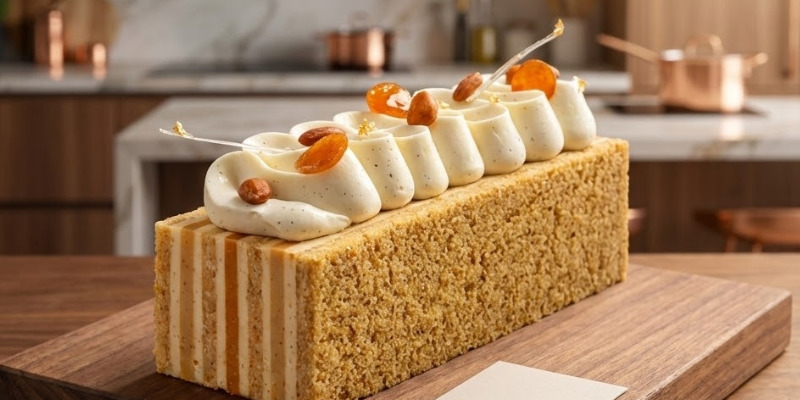
Bûche Frivole by Yann Brys — Vanilla, Turrón Cream, and Corsican Clementine Entremets
A Symphony of Citrus and Nougat: Introduction to Bûche Frivole
In the pantheon of modern French pastry, Chef Yann Brys (Meilleur Ouvrier de France) is revered for his elegance and technique. The Bûche Frivole ("Frivolous Log") is a prime example of his style: sophisticated, airy, and texturally complex. Unlike traditional rolled logs, this is an Entremet Bûche, built in layers of rectangular precision.The flavor profile is a celebration of the Mediterranean winter. It pairs the warmth of Turrón (Spanish almond nougat) with the bright, floral acidity of Corsican Clementines. Structurally, it relies on the Vanilla Trocadéro Sponge—a biscuit that is far moister and richer than a standard genoise, owing to its high content of almond flour and butter.Why attempt this masterpiece? It is a lesson in balance. The richness of the Turrón Crémeux and the fat of the Trocadéro sponge are cut perfectly by the sharp clementine coulis. It teaches the importance of temperature-controlled emulsions and the precise architecture required to build a multi-layered cake that slices cleanly.
Course Dessert
Servings 10
Ingredients
Vanilla Trocadéro Sponge
920gTPTalmond powder + icing sugar
60gcornstarch
300g+ 310 g egg whites
40gegg yolks
350gmelted butter40 °C
170gsugar
Turrón Crémeux
1076gheavy cream
160gegg yolks
12ggelatin powder + 84 g water
345gturrón paste
77galmond purée
Clementine Coulis with Rosemary
585gclementine purée
190gapricot purée
12glemon purée
3gfresh rosemary
50gsugar
16ggelatin powder + 112 g water
Vanilla Cream
300gheavy cream + 750 g more
2vanilla beansPapua New Guinea
80gegg yolks
65gsugar
12gfish gelatin powder + 84 g water
2galmond extract
Whipped Vanilla Mascarpone Cream
50gmilk
2vanilla beans + zest of 1 clementine
90gsugar
7ggelatin powder + 49 g water
200gmascarpone
1000gheavy cream
Decoration
Candied kumquat slices
Toasted whole almonds
White chocolate mikado sticks12 cm
Instructions
Vanilla Trocadéro Sponge
Mix TPT, cornstarch, yolks, and 300 g egg whites.
Whip the remaining 310 g egg whites with sugar.
Fold into base, then add melted butter at 40 °C.
Spread 1 kg per tray on silicone mat.
Bake at 165 °C for 10–12 minutes. Cool and cut in half.
Turrón Crémeux
Cook crème anglaise to 82 °C.
Add hydrated gelatin, emulsify with turrón and almond purée.
Cool to 35 °C, blend, pour into frame (37 × 57 cm).
Freeze at -20 °C, then cut in two rectangles.
Clementine Coulis
Mix purées (except ¼), heat ¼ with rosemary.
Infuse 5 min, strain, add sugar, heat.
Add gelatin, combine with rest, pour into 30 × 40 cm frame.
Freeze at -20 °C.
Vanilla Cream
Infuse cream with vanilla 5 min.
Temper with yolks and sugar, cook to 83 °C.
Strain over gelatin, blend.
Cool to 28 °C, add almond extract, fold in whipped cream.
Whipped Vanilla Mascarpone Cream
Infuse milk with vanilla and zest 5 min.
Add sugar, boil, melt gelatin in it.
Strain over mascarpone, blend.
Add cold cream, rest 12 h at 4 °C.
Whip to soft peaks before using.
Notes
The Science of Ingredients: Chemistry of Texture and Terroir
This recipe utilizes specific ingredients to create its signature mouthfeel.
1. Biscuit Trocadéro (The High-Fat Sponge)
The base is not a standard sponge; it is a Trocadéro.
The Science: A Trocadéro sponge is characterized by its use of TPT (Tant Pour Tant: 50% almond flour, 50% sugar) and a significant amount of melted butter added at 40°C. Unlike a sponge that relies solely on egg foam for structure, the Trocadéro relies on the almond meal and starch (cornstarch). The starch gelatinizes during baking to hold the structure, while the high fat content (butter + almond oil) ensures the cake remains "fudgy" and moist even when frozen and thawed, preventing it from drying out in the fridge.
2. Turrón Paste (The Emulsifier)
The crémeux is flavored with Turrón paste.
The Science: Turrón (or Torrone) is an emulsion of honey, sugar, egg whites, and toasted nuts. When used as a paste in a crémeux, it acts as a fat source and a sugar regulator. The nut oils in the paste help emulsify the heavy cream and egg yolks (Anglaise base), creating a texture that is denser and creamier than a standard fruit crémeux. The honey in the turrón adds hygroscopy, keeping the cream soft.
3. Corsican Clementines (Acid/Sugar Balance)
The recipe specifies Corsican Clementines.
The Science: Clementines from Corsica are prized for their high acidity and intense essential oils in the zest. In a coulis, this acidity is crucial. It lowers the pH of the mixture, which can affect how gelatin sets (acid weakens gelatin). However, the natural pectin in the apricot puree added to the recipe helps stabilize the texture. The acidity is the "palate cleanser" that prevents the dessert from becoming cloying.
4. Mascarpone (The Whipping Stabilizer)
The finishing cream uses Mascarpone.
The Science: Mascarpone is a cheese with 40%+ fat content. When mixed with heavy cream (35% fat), it raises the overall fat percentage of the mixture. This high fat content creates a rigid foam when whipped. Unlike pure whipped cream which can weep water (syneresis) after a few hours, the mascarpone-stabilized cream holds the intricate piped designs (like the signature tourbillon or swirls) for days without collapsing.
Essential Professional Kitchen Tools
To build this architectural log, precision tools are required.
Rectangular Frames (Cadres)
Why you need it: The recipe calls for specific frame sizes (37x57 cm, 30x40 cm). This is because the cake is built in large sheets and then cut. You cannot build this freehand. The frames contain the liquid mousses and coulis as they freeze, ensuring perfectly straight edges and uniform thickness for every layer.
Stick Blender (Immersion Blender)
Why you need it: For the Turrón Crémeux and Clementine Coulis. Emulsion is key. A whisk might leave small lumps of almond paste or fruit fiber. A stick blender homogenizes the fats and liquids, creating a glossy, smooth mouthfeel.
Spray Gun (Pistolet)
Why you need it: The finish is a Neutral Glaze Spray. To get a microscopic, even layer that makes the cake shine without looking "wet" or gloopy, a compressor spray gun is used. It atomizes the glaze. If you don't have one, you can carefully pour the glaze, but the layer will be thicker.
Digital Thermometer
Why you need it: Precision cooking is non-negotiable.
Crème Anglaise: Must reach 82°C-83°C.
Melted Butter: Must be 40°C before adding to the sponge batter.
Assembly: Mousses must be poured when they are fluid but cool enough not to melt the layer below.
Expert Tips and Success Hacks
Achieve the finesse of a MOF (Meilleur Ouvrier de France) with these secrets.
1. The Trocadéro "Fold"
The butter can deflate the eggs.
The Hack: When adding the 40°C melted butter to the whipped egg/almond mixture, do not dump it in. Sacrifice a small amount of the batter into the bowl of melted butter and whisk it vigorously to lighten the texture. Then fold that mixture back into the main batter. This prevents the heavy butter from sinking to the bottom and deflating your aeration.
2. Assembly Temperature
Layering liquids on solids.
The Hack: You are building this "Upside Down" or in layers inside a frame. Ensure each layer is frozen solid before pouring the next one. If the Turrón crémeux is soft when you spread the next layer of sponge or cream, they will bleed into each other, ruining the clean cut cross-section.
3. Cutting the Logs
How to get razor-sharp edges?
The Hack: Cut the frozen block into logs using a long, serrated knife dipped in hot water and wiped dry. Saw gently through the top layers, then press down firmly for the sponge. Clean the knife between every single cut. This prevents the Turrón cream from smearing onto the bright orange clementine layer.
4. Infusing the Milk
Don't waste the vanilla.
The Hack: For the Whipped Vanilla Mascarpone, infuse the vanilla beans and clementine zest in the hot milk for at least 20 minutes (covered) before straining. This "steeping" pulls out the complex floral notes that would otherwise be lost if you just mixed them in cold.
5. Turrón Paste Alternative
Can't find Turrón paste?
The Hack: Buy hard almond nougat (Alicante style) or soft nougat (Jijona style) and blitz it in a high-power food processor with a little neutral oil or almond oil until it turns into a smooth butter/paste. This mimics the commercial product perfectly.
Frequently Asked Questions (FAQ)
Q1: Can I use oranges instead of clementines?A: Yes, but reduce the sugar in the coulis slightly, as oranges are often sweeter and less acidic than Corsican clementines. You might want to add a splash of lemon juice to restore the tartness balance.Q2: Can I make this in a standard Yule Log mold?A: Yes. The recipe describes a "Frame" assembly (layered rectangle), but you can adapt it. Pipe the Turrón crémeux into a tube mold (insert). Pour the Vanilla Cream into a semi-circle log mold, push in the frozen Turrón insert, then seal with the Trocadéro sponge.Q3: How far ahead can I make it?A:
Frozen (Unfinished): The built cake can stay frozen in the frame for 3-4 weeks.
Finished (Decorated): Once glazed and decorated with mascarpone cream, it should be eaten within 24 hours. The whipped cream will eventually dry out in the fridge.
Q4: What is "TPT"?A: TPT stands for Tant Pour Tant (Equal for Equal). It is a mixture of 50% almond flour and 50% powdered sugar. If you don't have it, simply weigh equal parts of both and sift them together.Q5: Why did my Trocadéro sponge sink?A: This sponge is heavy in fat. If it sinks in the middle, it was likely underbaked. Because it's moist, the "toothpick test" can be tricky. Trust the baking time, but ensure it feels springy to the touch. Also, ensure you didn't over-mix the batter after adding the butter.