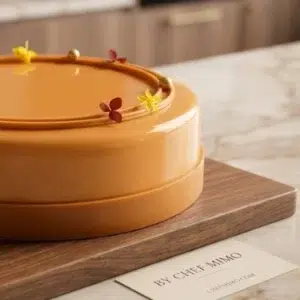
Caramel Passion Fruit Cake with Hazelnut Base and Gold Chocolate Glaze
A Symphony of Gold and Tang: Introduction to the Caramel Passion Entremet
In the world of modern pâtisserie, the "Gold" trend has taken center stage. Moving beyond traditional dark or milk chocolate, pastry chefs have embraced caramelized white chocolate (often known by the benchmark Callebaut Gold) for its complex notes of toffee, butter, and a hint of salt. This Caramel Passion Fruit Cake is a celebration of that flavor profile, expertly balanced by the electric acidity of exotic fruit.This entremet is not just a cake; it is an architectural study in flavor layering. It begins with a Hazelnut Sponge Base, roasted to bring out a deep, nutty aroma that grounds the dessert. The core is a dual-textured center: a silky Passion Fruit Crémeux cooked to precise custard temperatures, topped with a pure Passion Fruit Jelly Insert for a sharp burst of tartness. Enveloping this core is the Caramel Mousse, an airy yet rich cloud of caramelized white chocolate. Finally, the cake is robed in a Gold Caramel Mirror Glaze, offering a stunning amber shine that hints at the flavors within.Why is this a must-try recipe? It addresses the most common complaint about white chocolate desserts: sweetness. By pairing the intense sugar profile of the caramel chocolate with the aggressive acidity of passion fruit, the sugar is neutralized, leaving only the aromatic notes of toffee and fruit. It is a dessert that feels luxurious and heavy on the spoon, yet refreshing on the palate. Servings 8 people
Ingredients
🍈 Passion Fruit Crémeux
- ½ sheet gelatin
- 140 g quality white chocolate
- 2 egg yolks
- 15 g sugar
- 80 ml heavy cream
- Juice from 6 passion fruits
🌰 Hazelnut Sponge Base
- 120 g hazelnuts
- 120 g sugar
- 70 g egg whites
- 1 tsp vanilla paste
- 1 tsp all-purpose flour
🍈 Passion Fruit Insert
- ½ sheet gelatin
- 1 tbsp sugar
- Juice from 3 passion fruits
🍯 Caramel Mousse
- 3 sheets gelatin
- 300 g caramelized white chocolate Callebaut Gold
- 150 ml milk
- 300 ml heavy cream
✨ Gold Caramel Mirror Glaze
- 6 sheets gelatin
- 150 g caramelized white chocolate Callebaut Gold
- 100 ml heavy cream
- 50 ml water
- 150 g glucose syrup
- 150 g sugar
🍫 Decoration
- 200 g caramelized white chocolate
- Red wood sorrel or edible flowers
- Chocolate pearls
- 2 acetate strips 1 x 2 cm height for sides, 1 x 14–16 cm round for top
Instructions
Passion Fruit Crémeux (Day 1)
- Soak gelatin in cold water.
- Melt white chocolate over a bain-marie.
- Whisk egg yolks and sugar briefly.
- Heat cream and passion fruit juice until just below boiling.
- Pour over egg mixture, whisk, return to pan and heat to 83°C while stirring.
- Strain into a clean bowl. Add gelatin and stir. Pour over melted chocolate and combine.
- Pour into a 16 cm silicone mold or lined springform. Freeze for 3 hours.
Hazelnut Base
- Preheat oven to 200°C.
- Roast hazelnuts on parchment for 8 minutes. Let cool slightly and rub off skins in a tea towel.
- Coarsely blend hazelnuts.
- In a bowl, mix sugar, vanilla, and hazelnuts. Gradually add egg whites while whisking.
- Fold in flour. Pour into a 16 cm pan lined with parchment.
- Bake ~20 minutes. Cool completely. Freeze with parchment underneath.
Passion Fruit Insert
- Soak gelatin in cold water.
- Heat passion fruit juice and sugar in a small saucepan until hot (not boiling).
- Stir in gelatin. Let cool for 5–10 minutes.
- Remove frozen crémeux, pour insert mixture on top, and return to freezer overnight.
Caramel Mousse (Day 2)
- Soak gelatin in cold water.
- Melt caramelized chocolate over bain-marie.
- Heat milk to just under boiling, dissolve gelatin, and stir into melted chocolate.
- Whip cream to soft peaks. Gently fold into chocolate mixture in batches.
- Pour ⅓ of the mousse into an 18 cm silicone mold.
- Add frozen crémeux + insert center (insert side down). Pour remaining mousse.
- Remove hazelnut base from freezer, peel off parchment, and press gently into mousse.
- Freeze overnight.
Gold Caramel Glaze (Day 3)
- Soak gelatin in cold water.
- Place chopped gold chocolate in a tall container.
- In a saucepan, heat cream, water, glucose, and sugar to boiling.
- Add gelatin to hot mixture and pour over chocolate.
- Blend with immersion blender, avoid air bubbles.
- Cover with plastic wrap in contact and cool to 36°C.
Assembly & Glazing
- Unmold frozen cake and place on a rack or cup.
- Pour glaze evenly over cake.
- Remove glaze drips from base and transfer to serving dish.
- Let thaw in fridge for a few hours or overnight.
Chocolate Decoration
- Cut two acetate strips:
- One long (height: ~2 cm, length: to wrap cake)
- One round (~14–16 cm diameter) for the top decor
- Temper caramelized white chocolate (to ~29°C).
- Spread over acetate, then comb through the top piece for texture.
- Wrap acetate around 18 cm and 14/16 cm rings. Chill or freeze 10+ minutes.
- Remove acetate and place chocolate band around cake.
- Decorate top with chocolate ring, chocolate pearls, and red wood sorrel.
Notes
The Science of Ingredients: The Alchemy of Gold Chocolate
To master this cake, one must understand the unique properties of its star ingredients.1. Caramelized White Chocolate (The Maillard Reaction)
This recipe relies heavily on "Gold" chocolate.- The Science: Standard white chocolate is cocoa butter, sugar, and milk solids. To create "Gold" chocolate, the manufacturer (or the chef) slowly heats the chocolate during production. This triggers the Maillard reaction—a chemical reaction between amino acids (in the milk proteins) and reducing sugars. This process turns the milk solids brown and creates new flavor compounds responsible for savory, toasted, and nutty notes. It transforms the chocolate from a simple sweet fat into a complex flavor carrier.
2. Passion Fruit Acid (The pH Balancer)
Passion fruit juice is highly acidic (pH ~2.8-3.2).- The Science: In the Crémeux, this acidity poses a challenge: it can curdle the heavy cream and egg yolks if heated too fast. However, when cooked correctly to 83°C, the acid helps to "cut" the fat molecules on the palate. Without this acid, the high fat content of the mousse (cream + cocoa butter) and the glaze (condensed milk + glucose) would coat the tongue and mute the flavors. The acid cleanses the palate, making the next bite of caramel taste just as impactful as the first.
3. Glucose Syrup (The Elasticity Agent)
The glaze calls for 150g of glucose syrup.- The Science: A mirror glaze needs to be fluid enough to pour but viscous enough to cling to the vertical sides of a cake. Glucose syrup provides this "body." More importantly, it acts as an interfering agent. It prevents the sucrose (table sugar) from recrystallizing into a grainy texture as the glaze cools. This ensures the final coat remains perfectly smooth and reflective, like a mirror.
4. Hazelnuts (Oil Release)
The base uses 120g of roasted hazelnuts.- The Science: Roasting the nuts before grinding them is not just for flavor; it changes the texture. Heat expands the plant cells and releases the natural hazelnut oil. When mixed into the sponge batter, this oil provides a softer, moister crumb than butter alone could achieve. It also prevents the sponge from freezing into a rock-hard disc, ensuring it remains tender even when eaten semi-frozen.
Essential Professional Kitchen Tools
This recipe involves advanced techniques like tempering and glazing. Here are the tools to ensure success.-
Digital Thermometer (Instant Read)
-
Why you need it: Precision is non-negotiable here.
- Crémeux: Must reach 83°C. At 85°C, the eggs scramble.
- Glaze: Must be poured at 36°C. At 40°C, it melts the mousse; at 30°C, it sets in lumps.
- Tempering: Chocolate decor requires specific temperature curves (melting, cooling, reheating) to snap correctly.
-
Why you need it: Precision is non-negotiable here.
-
Acetate Strips (Cake Collars)
- Why you need it: For the decoration. You cannot create smooth chocolate bands or rings using parchment paper (which wrinkles) or foil. Acetate is a stiff, food-grade plastic that gives chocolate a glossy shine where it touches the plastic and allows you to curve the chocolate while it sets.
-
Immersion Blender
- Why you need it: For the Mirror Glaze. A whisk introduces air bubbles which ruin the "glass" effect. An immersion blender, kept submerged, creates a vortex that emulsifies the water, fat, and sugar into a seamless liquid without incorporating air.
-
Silicone Molds (Insert & Main)
- Why you need it: You need two sizes: a 16cm mold for the frozen center (crémeux + jelly) and an 18cm mold for the final cake. This 2cm gap allows the caramel mousse to completely encase the center, creating the surprise cross-section when sliced.
Expert Tips and Success Hacks
Achieve a boutique-bakery finish with these five professional secrets.1. The "Skin" Technique for Hazelnuts
Roasted hazelnut skins can be bitter and papery.- The Hack: Immediately after roasting, wrap the hot nuts in a clean, rough kitchen towel. Rub them vigorously against each other inside the towel. The steam and friction will peel the skins off efficiently. Don't worry if small specks remain—they add rustic character—but aim to remove 90% of the skins for a cleaner flavor.
2. Glazing Temperature: The "Gold" Rule
Dark chocolate glazes are often poured at 35°C, but white/gold chocolate glazes behave differently.- The Hack: Because white chocolate has no cocoa solids (only fat), it is more fluid. This recipe recommends 36°C to 37°C. If you pour it too cool, it becomes rubbery very fast. Always perform a "spoon test" (coat a spoon and watch the drip) before pouring over your frozen cake.
3. The Double-Freeze Insert
The recipe calls for a Crémeux layer and a Jelly layer.- The Hack: Do not pour the warm jelly liquid directly onto the unfrozen crémeux; they will mix into a muddy soup. Freeze the Crémeux solid (3 hours) first. Then pour the warm passion fruit jelly on top. The cold crémeux will help set the jelly bottom instantly, creating a razor-sharp line between the creamy yellow and the translucent orange layers.
4. Acetate Decor Timing
Making the chocolate band requires timing, not just temperature.- The Hack: Spread the tempered chocolate on the acetate strip. Wait until the chocolate loses its "wet" sheen and becomes matte but is still flexible (the "soft set" stage). Then pick it up and wrap it around your cake ring. If you move it while wet, it will run; if you wait until it snaps, it will crack.
5. Removing Condensation
Condensation is the enemy of the mirror glaze.- The Hack: When you pull the frozen mousse cake from the freezer to glaze it, a layer of frost forms instantly. Quickly rub the surface of the cake with your warm, bare hand to melt the frost and smooth the surface. Glaze poured over frost will slide off; glaze poured over mousse will stick.
Frequently Asked Questions (FAQ)
Q1: Can I use regular white chocolate if I can't find Gold/Caramelized chocolate? A: Yes, but you will lose the signature toffee flavor. To mimic it, you can "caramelize" your own white chocolate by roasting chopped white chocolate on a baking sheet at 120°C (250°F) for 45-60 minutes, stirring every 10 minutes until it turns amber. Alternatively, use regular white chocolate and add a teaspoon of caramel extract, though the depth of flavor won't be quite the same. Q2: Can I use store-bought passion fruit puree instead of fresh juice? A: Absolutely, and it is often preferred in professional kitchens for consistency. Fresh passion fruits can vary in acidity and water content. Store-bought 100% frozen puree (like Boiron or Ravifruit) guarantees the same pH and flavor intensity every time. Q3: How long can I keep this cake? A: This is a "make-ahead" friendly cake.- Frozen (Unglazed): Up to 3 weeks wrapped tightly.
- Glazed (Thawed): 2 days in the fridge. After 48 hours, the gelatin in the glaze may start to dry out and lose its shine, and the hazelnut base may absorb moisture from the mousse.