The Jewel of Frankfurt: Introduction to the Crown Cake
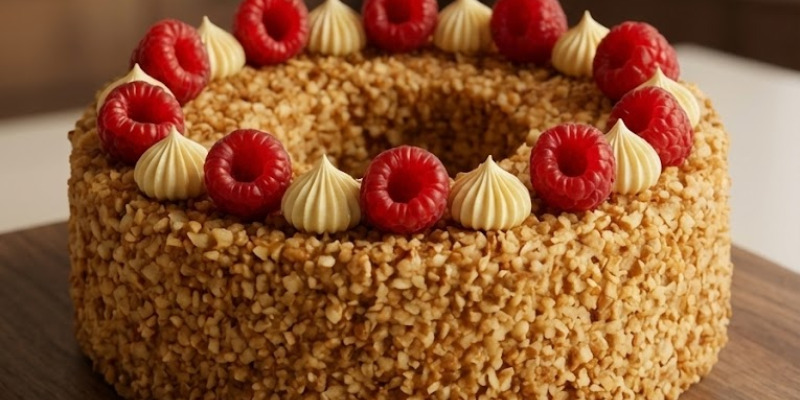
The Frankfurter Kranz (Frankfurt Crown Cake) is the regal matriarch of German buttercreams. Shaped like a ring to symbolize a crown, coated in golden hazelnut brittle (Krokant) to represent gold, and studded with ruby-red raspberries (or cherries), it is a cake of celebration.This modern interpretation refines the heavy classics of the past. It uses a Wiener Boden (Vienna Sponge) for a texture that is airy yet sturdy enough to be sliced into three layers. The filling is a Whole-Egg French Buttercream—richer than Swiss, but lighter than American—infused with Raspberry Brandy (Himbeergeist). A sharp Raspberry Jelly cuts through the fat, providing a bright, acidic counterpoint to the hazelnut praline exterior.Why master this? It teaches the architecture of "Kranz" (wreath) cakes, the science of Whole-Egg Foams for buttercream stability, and the texture management of applying brittle to a soft cream surface.
Prep Time 45 minutesminutes
Cook Time 15 minutesminutes
Servings 8people
Ingredients
🍰 Viennese Sponge Wiener Boden
4eggsseparated
100gsugar
50gspelt flourType 630
50gcornstarch
1tspvanilla sugar
Zest of ½ lemon
50gmelted butter
1pinchof salt
🍇 Raspberry Jelly & Syrup
200gfrozen raspberries
100ggelling sugar2:1
Juice of ½ lemonfor jelly
140gwater
70gsugar
Juice of ½ lemonfor syrup
30graspberry brandy
🧈 French Buttercream
4eggs
200gsugar
1tspvanilla paste
1pinchof salt
400gunsalted buttersoftened
40graspberry brandy
🌰 Decoration
200ghazelnut brittleKrokant
Fresh raspberriesfor garnish
Instructions
🟡 Viennese Sponge
Preheat the oven to 180°C (356°F). Grease and flour the sides of an 18 cm springform pan and line the bottom with parchment.
Whip the egg whites with a pinch of salt, gradually adding the sugar, until stiff peaks form.
Beat in the egg yolks, vanilla sugar, and lemon zest.
Sift together flour and starch, then fold into the egg mixture.
Gently incorporate the melted (but not hot) butter.
Pour the batter into the prepared pan and bake for ~20 minutes.
Immediately flip the baked sponge onto parchment to keep it moist while cooling.
🔴 Raspberry Jelly & Syrup
For the jelly: Purée thawed raspberries and strain to remove seeds. Cook with gelling sugar for 3 minutes. Add lemon juice and transfer to a bowl. Let cool.
For the syrup: Boil water, sugar, and lemon juice. Once cooled to room temperature, stir in raspberry brandy. Chill until needed.
🧁 French Buttercream
In a heatproof bowl, whisk together eggs, sugar, vanilla paste, and salt over a water bath until the mixture reaches 45°C (113°F).
Remove from heat and beat until fluffy and fully cooled.
In another bowl, whip the softened butter until pale and creamy.
Gradually incorporate the egg mixture into the butter until smooth.
Add raspberry brandy and mix until fully combined.
🏗 Assembly
Slice the cooled sponge into 3 even layers. Use a round cutter to remove a small center hole (~8 cm) from each.
Place the first sponge layer in a cake ring. Brush with raspberry syrup.
Spread half the raspberry jelly over the sponge. Then add ~200 g of buttercream and smooth it out.
Repeat with the second layer. Top with the third sponge layer.
Chill the assembled cake overnight to set.
🎨 Finishing
Soften the remaining buttercream slightly by warming it gently. Reserve ~100 g for piping.
Use the rest to evenly coat the top and sides of the cake.
Hold the cake gently and press the hazelnut brittle all around the surface.
Transfer to a serving plate.
Fill a piping bag with a star tip and pipe 12 buttercream rosettes on top.
Garnish each rosette with a halved fresh raspberry.
Notes
The Science of Ingredients: Chemistry of the Crown
To build a stable ring cake with distinct layers, we rely on specific ingredient mechanics.
1. Wiener Boden (The Starch-Heavy Sponge)
The sponge uses a 50/50 ratio of Spelt Flour to Cornstarch.
The Science: A "Vienna Sponge" is defined by the addition of melted butter to an egg foam. By using 50% Cornstarch, we significantly lower the gluten content. Starch gelatinizes during baking to set the structure, but without the elasticity of gluten. This creates a "short," tender crumb that dissolves on the tongue, contrasting with the crunch of the brittle.
2. Whole-Egg Buttercream (The "Parfait" Base)
The recipe calls for heating whole eggs and sugar to 45°C, then whipping.
The Science: While classic French buttercream uses yolks and syrup, this method uses whole eggs. Heating them to 45°C relaxes the protein bonds (globulins), allowing them to unfurl and trap maximum air during whipping. As they cool, these proteins re-bond around the air bubbles, creating a stable, voluminous foam. When butter is emulsified into this foam, the result is a buttercream that tastes lighter and less fatty than one made with butter and sugar alone.
3. Gelling Sugar 2:1 (The Acid-Pectin Matrix)
The jelly uses "Gelierzucker 2:1".
The Science: This sugar contains pectin and citric acid calibrated to set twice its weight in fruit. Raspberries are naturally low in pectin. The added pectin in the sugar relies on the acidity of the berries (and added lemon juice) to form a gel network. This ensures the jelly layer is firm enough to not squeeze out when the cake is sliced, yet soft enough to spread.
4. Raspberry Brandy (Alcoholic Extraction)
The Science: Alcohol is a solvent. Raspberry Brandy (Himbeergeist) carries volatile aromatic compounds that water cannot. Adding it to the buttercream disperses the berry aroma throughout the fat (butter), creating a 3D flavor experience where the nose detects the fruit before the tongue tastes the cream.
Essential Professional Kitchen Tools
To achieve the perfect "Crown" shape, you need specific geometry.
Springform Pan (18cm)
Why you need it: Unlike a standard layer cake, the "Kranz" needs a hole in the middle. If you don't have a specialized ring pan, bake a round sponge in a springform pan and use a round cutter (8cm) to punch out the center after baking.
Digital Thermometer
Why you need it: Crucial for the Buttercream Base. You must heat the eggs to 45°C.
<40°C: The sugar won't dissolve fully, leading to a gritty cream.
>55°C: The eggs will begin to coagulate (scramble), resulting in lumps.
Serrated Bread Knife
Why you need it: To slice the delicate sponge into three even layers. A straight blade will squash the airy Wiener Boden.
Cardboard Cake Round
Why you need it: Coating the side of a cake with brittle is messy. Holding the cake on a cardboard round allows you to tilt it over a tray of brittle and press the nuts onto the cream with your hand without touching the cake itself.
Expert Tips and Success Hacks
Achieve the golden finish of a German Konditorei with these secrets.
1. The "Moisture Flip"
Sponges dry out as they cool.
The Hack: Immediately after baking, flip the hot sponge onto a sheet of parchment paper sprinkled with sugar (to prevent sticking). Leave the mold on top (or cover with a towel). The trapped steam migrates back into the cake, ensuring the crust stays soft and the crumb remains moist.
2. Buttercream Temperature Sync
The biggest cause of broken buttercream is temperature shock.
The Hack: The whipped egg foam and the soft butter must be the same temperature (approx 20°C-22°C). If the butter is too cold, you get lumps. If the egg foam is still warm from the water bath, the butter melts into soup. Touch the bowl of eggs—it should feel neutral, not warm—before adding the butter.
3. The "Crumb Coat" for Brittle
The Hack: Apply the buttercream in two stages. First, a thin "crumb coat" to seal the sponge. Chill for 10 minutes. Then apply the thick final coat. This ensures that when you press the Hazelnut Brittle onto the sides, you aren't pushing crumbs into your final finish, and the cream is firm enough to hold the weight of the nuts.
4. Punching the Hole
The Hack: If making the hole manually, cut it after slicing the three layers. Stack them, align them, and cut the center hole through all three at once. This ensures a perfectly vertical "chimney" in the center of your crown.
5. Jelly Adhesion
Slippery jelly causes layers to slide.
The Hack: Pipe a "dam" of buttercream around the inner and outer edges of the sponge ring before spreading the raspberry jelly. This holds the jelly inside and prevents the cake layers from sliding apart when you coat the exterior.
Frequently Asked Questions (FAQ)
Q1: Can I make this without alcohol?A: Yes. Substitute the Raspberry Brandy with Raspberry Syrup (boiled reduction of juice and sugar) or simply omit it. The flavor will be less aromatic but still delicious.Q2: What is "Hazelnut Brittle" (Krokant)?A: Krokant is chopped nuts (usually hazelnuts) roasted in caramelized sugar. You can buy it ready-made in Germany, or make it by melting sugar to amber, stirring in chopped nuts, pouring onto a silicone mat to cool, and crushing it into small pieces.Q3: Can I use store-bought raspberry jam?A: Yes, but choose a high-quality jam with seeds removed (or strain it). Store-bought jam is often sweeter than the homemade jelly in this recipe, so you might want to reduce the sugar in the buttercream slightly to compensate.Q4: How long does it keep?A:
Storage: Keeps well for 2-3 days in the fridge. The buttercream protects the sponge.
Serving: Crucial! Remove from the fridge 30 minutes before serving. Cold buttercream is hard and waxy; room-temperature buttercream is soft and creamy.
Q5: Why did my sponge collapse?A: You likely folded the flour in too vigorously, knocking out the air bubbles, or the melted butter was too hot. The butter should be fluid but cool (around 30°C-40°C) when added.