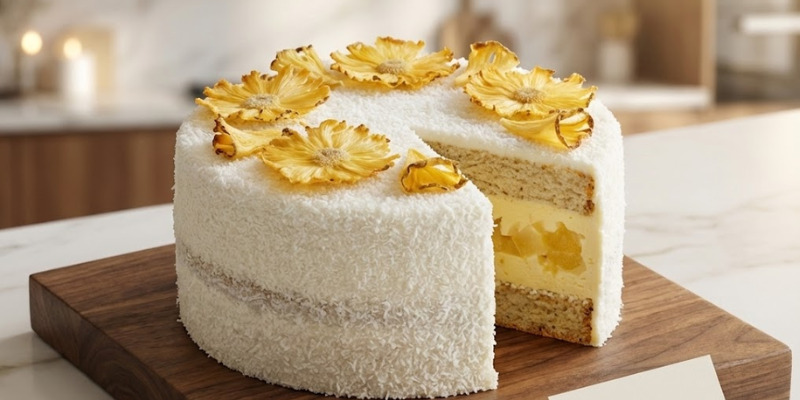
A Cloud of Coconut and Lime: Introduction to the Exotic Layer Cake
In the architecture of layer cakes, the sponge is the foundation. While butter cakes are dense and Genoise is dry, the Chiffon Cake stands apart as the ultimate vehicle for refrigerated desserts. This Exotic Layer Cake utilizes a Chiffon base—known for its reliance on oil and beaten egg whites—to create a texture that remains pillowy and soft even when chilled.The flavor profile is a tropical study in subtlety. It features the mild, creamy notes of Coconut, the sharp acidity of Lime, and the caramelized sweetness of Roasted Pineapple. The filling is a Whipped White Chocolate Ganache enriched with Mascarpone, providing a stability that standard whipped cream lacks.Why master this? It teaches the crucial technique of "Ungreased Baking" (essential for foam cakes), the science of Bromelain deactivation in pineapple, and the art of edible decoration with the Dried Pineapple Flowers. It is a dessert that looks intricate but relies on smart chemistry rather than difficult techniques.
Prep Time 1 hourhour
Cook Time 20 minutesminutes
Servings 12people
Ingredients
Whipped White Chocolate Ganache
210gheavy cream30% fat
210gcoconut creamor substitute regular heavy cream
310gwhite chocolateValrhona Ivoire recommended
500gmascarpone
Chiffon Cake
3eggs
80g+ 30 g granulated sugar
140gall-purpose flour
5gbaking powder
2gsalt
45gneutral oilgrape seed or sunflower
70gcoconut milkor substitute regular milk
Roasted Pineapple
1fresh pineapple600 g diced
1limezest only
Decoration optional
100gshredded coconut
1fresh pineapplefor dried pineapple flowers
Instructions
Preparation Notes
Prepare the ganache the day before assembling the cake.
If making dried pineapple flowers, prepare them the day before as well.
The chiffon cake can be baked on the same day or the day before. If preparing ahead, store in an airtight container to retain moisture.
Optional: Dried Pineapple Flowers
Choose a pineapple that is not too ripe, and use a very sharp knife.
Peel the pineapple and remove all eyes using the tip of a small knife.
Slice very thin rounds — about 1 mm thick, almost transparent. This is crucial: if they’re too thick, they won’t dry properly.
Place slices on parchment paper and bake at 100°C (fan) for 30 minutes, flipping every 10 minutes.
Transfer slices into muffin tins or large half-sphere molds to form flower shapes.
Return to the oven for another 10–15 minutes, watching carefully (if the pineapple starts to brown too much, remove it).
Let the flowers cool and air-dry overnight in the mold.
Note: The slices will remain slightly soft — this is normal. They won’t have the texture of chips.
Whipped Ganache
Bring both the heavy cream and coconut cream to a boil.
Pour over the white chocolate in three additions, stirring well each time.
Blend with an immersion blender until smooth and shiny.
Cover with plastic wrap (touching the surface) and refrigerate overnight.
Add the mascarpone the next day during whipping.
Chiffon Cake
Preheat oven to 150°C (fan-assisted).
Separate the egg yolks and whites.
Mix the dry ingredients: flour, baking powder, salt, and 80 g sugar.
Whip the egg whites, gradually adding 30 g sugar until they form soft peaks (don’t overwhip!).
In a separate bowl, whisk the yolks with oil and coconut milk.
Combine the wet ingredients with the dry mixture using a spatula.
Fold in the whipped egg whites carefully until the batter is smooth.
Pour into an ungreased 18 cm mold or ring — the batter needs to cling to the sides to rise properly.
Bake for 1 hour at 150°C.
Let cool completely before unmolding by running a thin knife along the edge.
Roasted Pineapple
Peel the pineapple and cut it into ½ cm slices, then into small dice — aim for 600 g of diced fruit.
Tip: In the photos, the pineapple chunks are too large. Keep them small to avoid trouble during slicing.
Heat a skillet over high heat and sauté the pineapple for 10 minutes until golden.
Drain in a colander and let cool completely.
Add lime zest and mix well.
Assembly
Slice the chiffon cake into 3 even layers.
Trim the domed top if necessary.
Save the flattest layer for the top.
Place the first layer directly onto your serving plate.
Whip the ganache until it begins to thicken.
Add half the mascarpone and continue whipping.
Add the rest and whip until firm peaks form.
⚠️ Be careful — the ganache can go from soft to stiff very quickly.
Set aside one-third of the whipped ganache for coating and decoration.
Use a piping bag with a large round tip for clean assembly (optional — a spatula also works).
Spread a thin layer of ganache over the first cake layer, then pipe a ring of ganache around the edge.
Fill the center with half the roasted pineapple, pressing gently with a spoon.
Add another layer of ganache and place the second cake layer on top.
Repeat: ganache, pineapple, ganache, and top layer (smooth side up).
Fill any gaps with the reserved ganache and smooth the surface.
If you want a fully white finish, mask all visible sponge.
I chose to leave the sides partially exposed for a rustic look.
Decoration (Optional)
Coat the sides with shredded coconut.
If the ganache is too soft, chill the cake briefly before coating.
Use leftover ganache to attach dried pineapple flowers — dab a little behind each slice and press gently onto the cake.
Notes
The Science of Ingredients: Chemistry of Foam and Fat
This recipe balances the lightness of the sponge with the richness of the cream.
1. Neutral Oil (The Anti-Staling Agent)
The Chiffon cake uses 45g of oil instead of butter.
The Science: Butter contains saturated fats that are solid at room temperature and rock-hard in the fridge. Oil contains unsaturated fats that remain liquid at 4°C. Since this cake is filled with perishable cream (mascarpone/ganache), it must be refrigerated. A butter cake would turn hard and dry in the fridge; an oil-based Chiffon remains incredibly moist and tender, melting on the tongue instantly.
2. Un-Greased Pan Physics
The instructions explicitly say: "Do not grease your mold."
The Science: Chiffon batter relies on an egg-white foam for lift. It is delicate. As it rises in the oven, the proteins physically "climb" the walls of the metal pan, gripping the microscopic texture of the aluminum. If you grease the pan, the batter slips and slides down, resulting in a flat, dense disc rather than a high-rising, airy sponge.
3. Mascarpone (The Coconut Stabilizer)
The ganache uses 500g of Mascarpone with Coconut Cream.
The Science: Coconut cream has a high water content and a fat structure that melts easily (approx 24°C). If you whipped coconut cream alone, it would be weak. Mascarpone (40%+ dairy fat) provides the rigid fat crystals needed to create a stable foam. It acts as the structural scaffolding, allowing the ganache to hold the weight of the cake layers without squishing out the sides.
4. Pineapple Bromelain (Heat Deactivation)
We roast the pineapple before filling.
The Science: Raw pineapple contains Bromelain, a protease enzyme that digests protein. If you put raw pineapple next to a dairy-based cream (protein), it can slowly digest the cream, turning it bitter and watery, or prevent gelatin from setting. Roasting the pineapple at high heat (sautéing) denatures (kills) this enzyme, making it safe to use in dairy desserts, while also caramelizing the fruit sugars for depth.
Essential Professional Kitchen Tools
To achieve the "Exotic" look, precise tools are non-negotiable.
Tall Anodized Aluminum Pan (18cm)
Why you need it: You need a pan with high sides (at least 7-10cm) or a tall cake ring. Aluminum heats evenly and provides the "grip" needed for the chiffon to rise. Non-stick pans are the enemy of Chiffon cakes.
Mandoline Slicer
Why you need it: For the Dried Pineapple Flowers. To dry properly without burning, the slices must be paper-thin (1mm) and uniform. A knife is often too inconsistent. A mandoline ensures translucency.
Immersion Blender
Why you need it: For the Ganache Base. Coconut cream often separates into water and fat solids. The immersion blender forces these phases together with the white chocolate into a perfect, glossy emulsion before the overnight chill.
Serrated Bread Knife
Why you need it: Chiffon cake is as soft as a cloud. A straight-edge chef's knife will squash the sponge, compressing the air bubbles you worked so hard to create. A serrated knife saws through the delicate crumb without damaging the structure.
Expert Tips and Success Hacks
Achieve the height and finish of a bakery cake.
1. Gravity Cooling
Chiffon cakes collapse under their own weight when hot.
The Hack: Immediately after taking the cake out of the oven, flip the pan upside down. If using a dedicated tube pan, rest it on its feet. If using a ring or standard pan, prop the edges up on three cans or bowls. Gravity pulls the cake down (which is technically up relative to the cake top), stretching the protein structure while it sets. Cool completely upside down.
2. The "Dry" Pineapple Rule
Moisture is the enemy of layer cakes.
The Hack: After sautéing the pineapple, let it drain in a colander for at least 30 minutes. If you put wet pineapple inside the cake, the juice will soak into the chiffon, creating "soggy bottom" layers that break when you slice the cake.
3. Whipping Caution
Mascarpone + White Chocolate = Rapid Seizure.
The Hack: When whipping the chilled ganache with mascarpone, watch it like a hawk. It goes from "liquid" to "perfect stiff peak" to "curdled butter" in about 20 seconds. Stop the mixer the moment it holds a peak. Do not walk away.
4. Pineapple Flower Timing
The Hack: The flowers need low, slow heat. If your oven runs hot, prop the door open with a wooden spoon to release moisture. They are done when they feel like dry leather, not like crisp chips. They will firm up as they cool in the muffin tin (which gives them the curved flower shape).
5. Coconut Flavor Boost
Coconut cream can be mild.
The Hack: To amplify the tropical profile without adding liquid, toast the Shredded Coconut for the decoration until golden brown. The Maillard reaction on the coconut meat releases aromatic oils that smell much stronger than raw coconut.
Frequently Asked Questions (FAQ)
Q1: Can I use canned pineapple?A: Yes. Drain it very well. Canned pineapple is already cooked, so the enzyme issue is solved, but sautéing it with the lime zest is still recommended to drive off excess canning syrup water and develop flavor.Q2: Why did my cake fall out of the pan when cooling upside down?A: You likely greased the pan, or the pan was non-stick. The cake needs to stick to the bottom (which is the top when flipped) to hang suspended. If it slips out, it will crash onto the counter and collapse.Q3: Can I make the ganache dairy-free?A: It is difficult. You can substitute the heavy cream and mascarpone with Full Fat Coconut Cream (chilled, solid part only), but it will be softer and melt faster at room temperature. You would likely need to add gelatin or agar to stabilize it for a layer cake.Q4: How far ahead can I make this?A:
Chiffon Cake: Can be baked 1 day ahead (wrapped airtight).
Ganache Base: Must be made 1 day ahead (needs 12h chill).
Assembly: Best assembled on the day of serving or 1 day prior. The moisture from the pineapple eventually migrates into the cream.
Q5: Can I use a different fruit?A: Absolutely. Mango is a perfect substitute. Sauté firm mango cubes with lime. Or use Peaches with a touch of vanilla. The chiffon and white chocolate ganache are neutral enough to support almost any fruit.