Pistachio Orange Cake – Dubai-Style Elegance with Kunafa Crunch & Matcha Mousse
A Fusion of Middle Eastern Crunch and French Finesse
In the world of pastry trends, few flavor profiles have exploded quite like the "Dubai Chocolate" phenomenon—a viral combination of rich pistachio cream and the shattering crunch of toasted Kataifi (Kunafa) dough. This Pistachio Orange Cake takes that internet-famous concept and refines it into a high-end French entremet.This dessert is a textural masterpiece. It moves beyond the simple candy bar format to offer a complex architecture: the airy lightness of a Pistachio Sponge, the ultra-creamy, fondant-like texture of an Orange Namelaka, the grassy earthiness of a Matcha Pistachio Mousse, and the signature "Dubai" element—a crispy, golden Kunafa Crunch layer bound with tahini and chocolate.Why make this specific cake? It bridges cultures. You have the citrus notes of the Mediterranean, the nutty depth of the Middle East, and the technical precision of French mousse-making. It balances the sweetness of white chocolate with the bitterness of matcha and the zest of orange, ensuring a sophisticated finish that is never cloying. Servings 12 people
Ingredients
Orange Namelaka
- 60 g milk
- Zest of ½ organic orange
- 90 g white couverture
- 1 gelatin sheet 1.7 g
- 30 g freshly squeezed orange juice
- 100 g cold liquid cream
Pistachio Sponge
- 2 egg whites L
- 50 g sugar
- 2 egg yolks L
- 30 g pistachio paste 100% pistachio
- 30 g all-purpose flour
- 30 g ground almonds or pistachios
- 15 g melted butter
“Dubai” Pistachio Kunafa Crunch
- 80 g kataifi dough kunafa strands
- 15 g butter
- 1 tsp tahini sesame paste
- 80 g pistachio paste 100% pistachio
- 35 g melted white couverture
Insert Assembly
- 1 –2 tbsp orange confit or high-quality orange marmalade
Pistachio Mousse with Matcha
- 120 g milk
- 30 g cream
- 2 g matcha powder
- 65 g pistachio paste 100%
- 3½ gelatin sheets 6 g
- 140 g white couverture
- 210 g whipping cream
Velvet Spray Optional for Finish
- 100 g cocoa butter
- 100 g white couverture
- Fat-soluble food coloring olive green & yellow
Instructions
Orange Namelaka
- Soak the gelatin in ice-cold water.
- Bring milk and orange zest to a boil.
- Pour hot milk over melted white chocolate.
- Add drained gelatin and mix thoroughly.
- Blend in orange juice and cold cream using an immersion blender for 1–2 minutes.
- Refrigerate until fully set and creamy.
Pistachio Sponge
- Preheat the oven to 180°C (356°F).
- Beat the egg whites with sugar until stiff peaks form.
- Gently mix in egg yolks and pistachio paste.
- Sift in flour and ground nuts, fold gently.
- Stir in melted butter.
- Spread on a silicone mat and bake for ~10 minutes.
- Cool and cut two 16 cm circles.
Dubai Pistachio Kunafa Crunch
- Roughly chop kunafa strands.
- Toast in a pan with butter until golden and crispy.
- Melt white chocolate and combine with pistachio paste and tahini.
- Add toasted kunafa and mix well.
Insert Assembly
- Place one sponge disc (baked side up) in a 16 cm ring or mold.
- Spread the pistachio kunafa crunch evenly on top.
- Add second sponge (baked side down), press lightly.
- Spread a thin layer of orange confit or marmalade.
- Top with the chilled orange namelaka.
- Freeze completely.
Pistachio Matcha Mousse
- Soak gelatin in ice-cold water.
- Heat milk and cream, sifting in matcha and stirring until combined.
- Pour over melted white chocolate, add gelatin and pistachio paste.
- Blend thoroughly until smooth.
- Let cool to ~30°C (86°F).
- Whip cream to soft peaks and fold into the cooled mixture.
Final Assembly
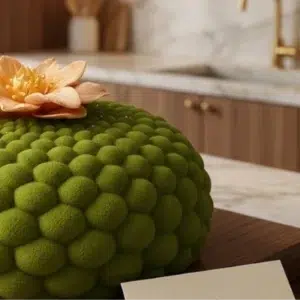
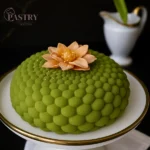
- Pour the pistachio mousse into the Pearls silicone mold by Dinara Kasko.
- Swirl the mold to coat its inner surface with mousse.
- Unmold the frozen insert and place it upside-down into the mousse.
- Cover and freeze overnight.
Velvet Spray Finish (Optional)
- Melt cocoa butter and white couverture at 45°C (113°F).
- Mix with fat-soluble coloring (olive and yellow).
- Spray the frozen cake evenly with the velvet mixture using a spray gun.
- Make sure no ice crystals are on the surface—wipe gently if needed.
- Let the cake thaw in the fridge and decorate as desired (e.g., with wafer flowers or gold pearls).
Notes
The Science of Ingredients: The Chemistry of Crunch and Cream
To master this cake, we must understand the specific roles of its unique ingredients.1. Kataifi (The "Dubai" Crunch)
The recipe calls for "Kunafa strands" or Kataifi dough.- The Science: Kataifi is a shredded phyllo dough made of flour and water. Unlike a cookie crumb, it has a very low fat content initially. By toasting it in butter until golden, you drive out all residual water, creating a rigid starch network. Crucially, mixing it with pistachio paste, tahini, and white chocolate creates a hydrophobic (water-repelling) coating. This fat barrier prevents the moisture from the mousse and marmalade from migrating into the dough, keeping it audibly crunchy inside the soft cake for days.
2. Namelaka (The Texture)
"Namelaka" implies a texture distinct from ganache or crémeux.- The Science: Meaning "ultra-creamy" in Japanese, Namelaka is a technique that uses a high ratio of milk to chocolate, stabilized by a small amount of gelatin. Unlike a mousse (which uses air bubbles) or a ganache (which is dense), Namelaka relies on the slow crystallization of the cocoa butter in the white chocolate over 12–24 hours. This creates a texture that is sliceable yet melts instantly on the tongue like soft butter.
3. Matcha (The Bitterness Balancer)
Matcha powder is added to the pistachio mousse.- The Science: Pistachio paste and white chocolate are both naturally sweet and fatty. Without a counterpoint, the mousse could feel heavy ("fatigue") on the palate. Matcha contains catechins, which provide astringency and bitterness. This bitterness cuts through the fat, cleansing the palate and making the pistachio flavor pop more vibrantly without needing extra salt.
4. Tahini (The Emulsifier)
A teaspoon of tahini is added to the crunch layer.- The Science: Tahini is sesame paste. It adds a savory, roasted undertone that deepens the pistachio flavor. Chemically, it acts as a secondary fat source that lowers the melting point of the mixture slightly, ensuring the crunchy layer doesn't freeze into a rock-hard disc that is impossible to cut with a spoon.
Essential Professional Kitchen Tools
This cake requires tools that handle precise textures and shapes.-
Silicone "Pearl" or "Cloud" Mold
- Why you need it: The recipe mentions the Dinara Kasko Pearls mold, which creates a stunning, bubbly surface. Standard metal rings cannot achieve this 3D geometry. If you don't have this specific brand, any high-quality silicone "cloud" or "bubble" mold will work to create that modern aesthetic.
-
Velvet Spray Gun
- Why you need it: To achieve the matte, fuzzy "velvet" finish, you need to spray the chocolate/cocoa butter mixture. A simple brush cannot create this texture. The mixture must be atomized into a fine mist that freezes instantly upon contact with the frozen cake.
-
Immersion Blender
- Why you need it: Crucial for the Namelaka. Whisking a high-moisture ganache like Namelaka often separates the fat or creates bubbles. An immersion blender forces the fat and water phases together into a perfect emulsion, giving the cream its signature glossy, elastic look before setting.
-
16cm Cake Ring
- Why you need it: This is for the "Insert" (sponge + crunch + namelaka). The insert must be smaller than the final mold (usually 18-20cm) so that the mousse can completely envelop it, hiding the layers until the first slice is cut.
Expert Tips and Success Hacks
Here are five secrets to ensuring your Dubai-style entremet is flawless.1. The "Golden" Rule for Kunafa
Do not under-toast the kataifi.- The Hack: The kataifi strands must be toasted to a deep, brownish-gold, not just pale yellow. If they are pale, they retain moisture and will become chewy (like raw dough) rather than crispy inside the cake. Listen for the sound—it should sound like dry leaves rustling in the pan.
2. Namelaka Patience
You cannot rush the crystallization.- The Hack: Make the Namelaka the day before. If you try to assemble the cake with freshly made Namelaka, it will be too runny and will bleed into the crunch layer. It needs 12 hours in the fridge to reach its "pipable" consistency.
3. The "Upside Down" Assembly
Using intricate silicone molds requires reverse thinking.-
The Hack: When using a Pearl/Bubble mold, you assemble upside down.
- Pipe/Pour the Pistachio Mousse into the bottom of the mold.
- Use a spoon to push mousse up the sides, eliminating air bubbles in the "pearls."
- Push the frozen insert (Sponge + Crunch + Namelaka) into the mousse, with the Namelaka side facing down (into the mousse) and the sponge side facing up (which will become the bottom of the cake).
4. Protecting the Velvet Spray
Velvet spray is delicate.- The Hack: Once sprayed, do not touch the cake with your fingers. The heat from your skin will melt the cocoa butter crystals instantly, leaving fingerprints. Move the cake using an offset spatula inserted under the base.
5. Matcha Clump Prevention
Matcha hates water and loves to clump.- The Hack: Never dump matcha powder directly into the liquid. Mix the matcha with a small amount of the sugar or whisk it vigorously into a small portion of the warm milk (making a paste) before adding it to the rest of the mousse base. This ensures a uniform green color without bitter specs of dry powder.
Frequently Asked Questions (FAQ)
Q1: Can I use regular shredded phyllo if I can't find "Kataifi"? A: Kataifi is shredded phyllo. However, if you can only find sheets of phyllo dough, you can use a sharp knife to slice the sheets as thinly as possible (vermicelli style). It won't be quite as airy, but it will provide a similar crunch once toasted with butter. Q2: What can I substitute for the "Pearls" mold? A: You can use a standard 18cm or 20cm metal cake ring (lined with acetate). If doing this, build the cake right-side up: Sponge at the bottom, then crunch, then namelaka, then pour the mousse over everything and smooth the top flat. Q3: Can I make this without a spray gun? A: Yes. You can use a Mirror Glaze (white chocolate based, colored green) instead of the velvet spray. Alternatively, you can cover the cake with chopped pistachios or simply dust it with matcha powder right before serving (though matcha absorbs moisture quickly, so do this last minute). Q4: Is the orange flavor necessary? A: The orange cuts the richness of the pistachio and white chocolate. If you dislike orange, Raspberry is an excellent substitute. Use raspberry confit instead of orange marmalade, and omit the zest in the Namelaka (making a plain vanilla Namelaka). Q5: How long does the crunch stay crispy? A: Thanks to the chocolate and tahini coating, the crunch stays perfectly crisp for 2 to 3 days in the refrigerator after the cake has thawed. After day 3, it may start to soften slightly but will still have texture.